Analisi esperta di Death of the Virgin di Bartolome Bermejo
Stile: Gothic · Genere: religious painting
Expert Analysis: "Death of the Virgin" by Bartolomé Bermejo (c. 1460-1490s, Gothic Style)
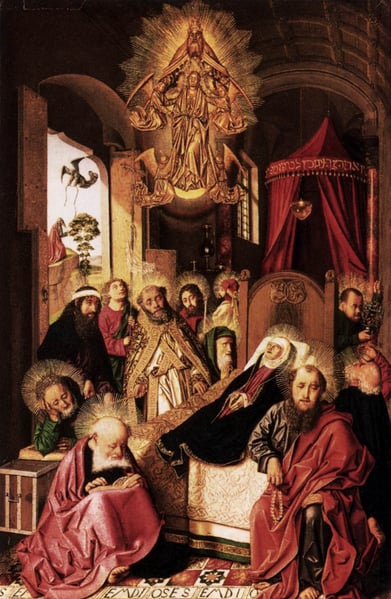
Bartolomé Bermejo, one of the most distinctive masters of the Hispano-Flemish Gothic tradition, elevates the religious subject of the Dormition of the Virgin into a powerfully emotional and technically masterful altarpiece. While the work adheres to the conventional Gothic iconography of the Virgin’s passing—surrounded by the sorrowing Apostles, Saint John holding a palm, and Christ receiving her soul—what sets this piece apart is Bermejo’s remarkable synthesis of three key influences: the meticulous, oil-glaze realism of the Northern Renaissance (particularly Jan van Eyck), the bright gold-leaf backgrounds and hieratic composition of the Spanish Gothic, and a raw, nearly tangible human pathos.
Significance within the Gothic Style & Period:
-
Technical Virtuosity in the Hispano-Flemish Mode – Bermejo’s use of oil paint allows for extraordinary detail: the sheen on fabrics, the translucent quality of skin, the reflective gleam of the Virgin’s halo. This Flemish-inspired naturalism brings a tactile immediacy to the sacred scene, making the figures feel present rather than merely symbolic. The rendering of the Apostles’ grief—furrowed brows, wet eyes, clenched hands—infuses the Gothic tradition with an unprecedented psychological depth.
-
Spatial Innovation within a Gold-Ground Format – Unlike many earlier Gothic works that flatten space, Bermejo creates a convincing interior setting: the bed recedes in perspective, the carved wooden canopy casts shadows, and the floor tiles angle convincingly. Yet he preserves the timeless, iconic gold ground above the scene, bridging the medieval love of celestial luminosity with Renaissance concern for earthly space.
-
Emotional Intensity as a Spanish Gothic Marker – Spanish Gothic painting often prized dramatic expression and devotional fervor. Bermejo amplifies this: the Apostles crowd around the deathbed, their poses twisting and overlapping in a near-theatrical display of mourning. The Virgin’s face is calm in holy sleep, but the surrounding agitation underscores the human cost of divine transition. This emotional charge anticipates the more passionate styles of the early Spanish Renaissance.
-
Cultural Fusion and Indigenous Identity – Bermejo worked in the Crown of Aragon (present-day Catalonia and Aragon), where Italian, Flemish, and local traditions collided. His “Death of the Virgin” stands as a landmark of this hybrid vigor: the landscape glimpsed through a window recalls Flemish panoramic views, while the heavy gold ornament and crisp linear contours remain decisively Iberian. It is a testament to how regional Gothic workshops absorbed international currents without losing their distinct character.
In summary, Bermejo’s Death of the Virgin is significant because it pushes the Gothic style to its expressive and technical limits—marrying the spiritual otherworldliness of medieval art with the observational rigor that would soon define the Renaissance. It is not merely a religious illustration but a meditation on mortality, sanctity, and the very humanity of the divine, rendered with a painterly skill that marks Bermejo as a pivotal figure in the transition from Gothic to early modern painting in Spain.
Genere
Stile
Visivamente simili
20 opere con composizione e palette affini
Dormition of the Virgin
Hans Holbein the Elder
Death of the Virgin
Hans Holbein the Younger
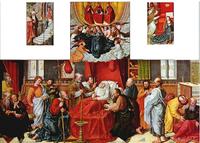
Polyptych with Death of the Virgin
Bernard Van Orley
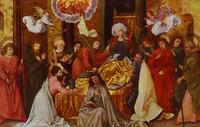
Death of the Virgin
Hans Holbein the Younger
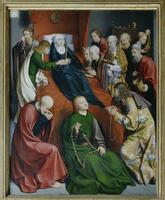
Dormition of the Virgin
Jan Joest
Adoration of the Magi
Quentin Matsys
Menino Jesus entre os Doutores
Cristovao de Figueiredo
Doge Alvise Mocenigo and Family before the Madonna and Child
Tintoretto
Twelve year old Jesus in the Temple
Albrecht Durer
Adoration of the Magi
Justus van Gent
Circumcision
Albrecht Durer
The Death of the Virgin
Petrus Christus
Trânsito da virgem
Cristovao de Figueiredo
Adoration of the Magi
Domenico Tintoretto
Bênção de Santa Auta em Lisboa
Cristovao de Figueiredo
Presentation of Jesus Christ at the Temple
Hans Holbein the Elder
Apresentação do Menino no Templo
Gregorio Lopes
Madonna and Child Enthroned with Four Saints
Lorenzo Lotto
The Annunciation
Hans Memling
Doge Alvise Mocenigo and Family Before the Madonna and Child
Tintoretto