Kiyoshi Saito sanatçısının Maiko III eseri hakkında uzman analizi
Tarz: Sōsaku hanga · Tür: figurative
Expert Analysis: "Maiko III" by Kiyoshi Saito
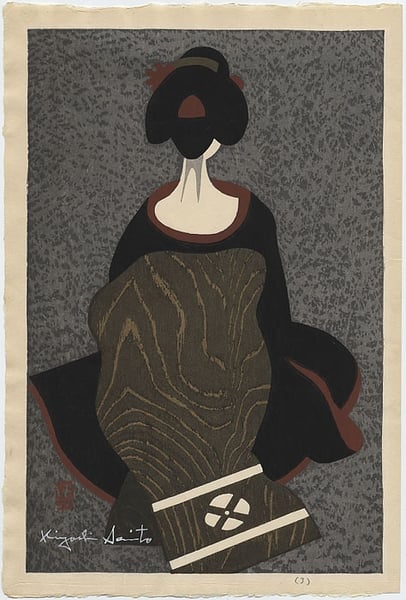
Kiyoshi Saito’s Maiko III is a quintessential example of the Sōsaku hanga (“creative print”) movement, which emerged in early 20th-century Japan as a radical departure from the traditional ukiyo-e workshop system. Unlike the collaborative model of carver, printer, and publisher, Sōsaku hanga artists like Saito insisted on designing, carving, and printing their own works—imbuing each print with a personal, expressive directness.
Significance within Sōsaku hanga:
- Self-expressive technique: In Maiko III, the hand-carved lines and bold, unmodulated color blocks reveal the artist’s physical touch. The grain of the wood and the slight unevenness of the inking are not flaws but deliberate markers of authenticity, celebrating the artist’s hand rather than mechanical perfection.
- Modernist abstraction of tradition: Saito takes the iconic figure of a maiko (apprentice geisha)—a classic subject in ukiyo-e—and transforms it through a modernist lens. The face is reduced to flat planes of pale skin, the kimono patterns are simplified into geometric shapes, and the background is starkly minimal. This distillation aligns with early 20th-century Western modernism (influences of Expressionism and Art Deco) while retaining a distinctly Japanese sensibility in its use of negative space and flattened perspective.
- Color and atmosphere: Saito often used muted, earthy tones, but here he employs a restrained palette—greys, blacks, and touches of red—to evoke the quiet, introspective world of the maiko. The red of the lips and collar accents become powerful focal points, drawing the eye while maintaining the print’s overall stillness.
Genre & cultural resonance: Though formally a figurative work, Maiko III is less a portrait of a specific person than a meditation on ritual, beauty, and the ephemeral nature of the geisha world. Saito’s maiko are often depicted with averted eyes, emphasizing anonymity and universal archetype rather than individual identity. This approach places the print within a broader post-war Japanese artistic dialogue: reinterpreting national heritage through a modern, individualistic practice.
In sum, Maiko III is significant for how it merges the handcrafted ethos of Sōsaku hanga with a refined, modern aesthetic, turning a traditional subject into a timeless, psychologically resonant image. It stands as a testament to Saito’s skill in balancing abstraction with cultural specificity—a hallmark of his best work and of the movement itself.
Tür
Stil
Görsel olarak benzer
İlişkili kompozisyon ve renk paletine sahip 20 eser
Maiko
Kiyoshi Saito
Maiko Kyoto (I)
Kiyoshi Saito
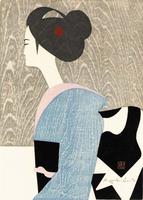
Maiko Kyoto (B)
Kiyoshi Saito

Dancing Figure (Eshima)
Kaoru Kawano
In a Long Undergarment (variant)
Torii Kotondo
February - Wintry Sky
Yamamura Toyonari
Le Mirror De Laque Rouge. Tokyo
Paul Jacoulet
A Lady
Torii Kotondo
In a Long Undergarment
Torii Kotondo
Sitting Lady
Shibata Zeshin
Before the Mirror
Ito Shinsui
A beauty holding a ball
Toyohara Chikanobu
Woman from Behind
Unichi Hiratsuka
Dancing Figure (Camellia)
Kaoru Kawano

Woman Looking at Herself in a Mirror
Katsushika Hokusai
Kesho (Make-up)
Toyohara Chikanobu
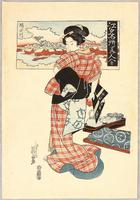
Beauty and Sumida River - Edo Meisho Bijin Awase
Keisai Eisen
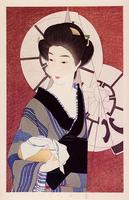
After the Bath
Torii Kotondo
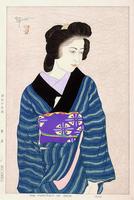
The Portrait of Okoi
Paul Jacoulet
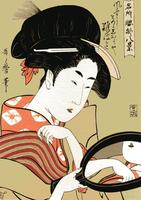
Utamaro Okita
Kitagawa Utamaro