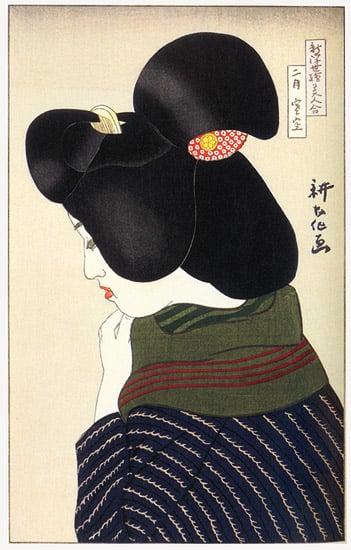
Expertenanalyse zu Yamamura Toyonaris February - Wintry Sky
Stil: Shin-hanga · Genre: portrait
Expert Analysis: "February – Wintry Sky" by Yamamura Toyonari
Yamamura Toyonari’s "February – Wintry Sky" stands as a notable example within the Shin-hanga movement, a 20th-century revival of ukiyo-e that fused traditional Japanese woodblock techniques with Western influences in composition, lighting, and atmospheric effect. As a portrait, the work exemplifies Shin-hanga’s focus on individual character and quiet introspection, moving beyond the conventional idealized beauties of earlier ukiyo-e to capture a more naturalistic, emotionally resonant likeness.
The season and title – "February – Wintry Sky" – are integral to the work’s significance. Shin-hanga artists often placed great emphasis on seasonal mood (kisetsu), and Toyonari uses the cold, subdued palette of winter to frame his subject. The wintry sky likely serves as a backdrop that imbues the portrait with a sense of stillness and melancholy, while the delicate rendering of the figure’s features, clothing, and posture reflects the shin-hanga aim of precise, almost photographic realism tempered by lyrical design. The interplay between the figure’s serene expression and the bleakness of the February sky creates a poignant tension – a hallmark of Toyonari’s ability to convey interior life through external environment.
What makes this portrait significant within the Shin-hanga period is its demonstration of Toyonari’s masterful integration of Western chiaroscuro and perspective with the flat, linear elegance of traditional Japanese printmaking. Unlike earlier ukiyo-e portraits, which often celebrated surface beauty, here the sitter’s individuality and the atmospheric weight of winter are given equal importance, marking a shift toward modern psychological depth. The print thus exemplifies Shin-hanga’s broader achievement: preserving the craft of woodblock printing while expanding its expressive range to capture the subtle transitions of human experience and nature.
Genre
Stil
Visuell ähnlich
20 Werke mit ähnlicher Komposition und Farbpalette
Sawamura Sonosuke I as Umegawa
Yamamura Toyonari
Before the Mirror
Ito Shinsui
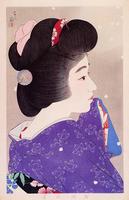
Misty Spring
Torii Kotondo
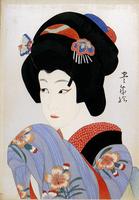
Ichikawa Shocho II as Oman
Yamamura Toyonari
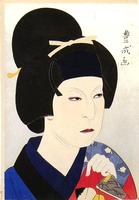
Nakamura Utaemon V as Owasa
Yamamura Toyonari
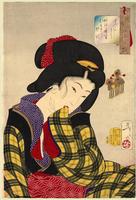
Looking shy - The appearance of a young girl of the Meiji era
Tsukioka Yoshitoshi
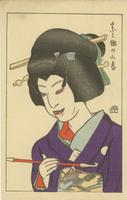
Sonosuke in the role of Koharu
Yamamura Toyonari
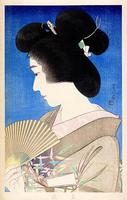
Summer Geisha
Torii Kotondo
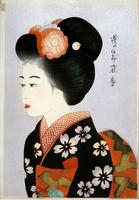
A Dancer of Kyoto
Yamamura Toyonari
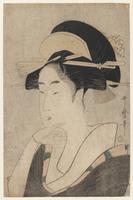
Large Head and Bust Portrait of Beauty
Kitagawa Utamaro
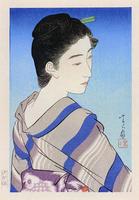
A Lady
Torii Kotondo
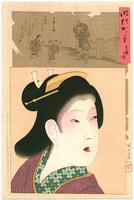
Kyouhou - Mirror of the Ages
Toyohara Chikanobu
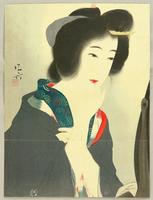
Untitled
Kiyokata Kaburagi
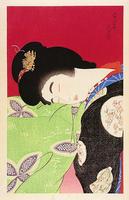
Taking a Nap
Torii Kotondo
Geisha
Kitagawa Utamaro
(Otonashisô, Tsukuda Shinchi no irifune), from the series Twelve Views of Modern Beauties (Imayô bijin jûni kei)
Keisai Eisen
Peony Snowflakes
Torii Kotondo
Looking eager to meet someone - The appearance of a courtesan of the Kaei period
Tsukioka Yoshitoshi
Secret love
Kitagawa Utamaro
Utamaro Okita
Kitagawa Utamaro