
Expertenanalyse zu Aurelie Nemourss Rythme du millimètre
Stil: Concretism · Genre: abstract
Expert Analysis: Rythme du millimètre by Aurelie Nemours
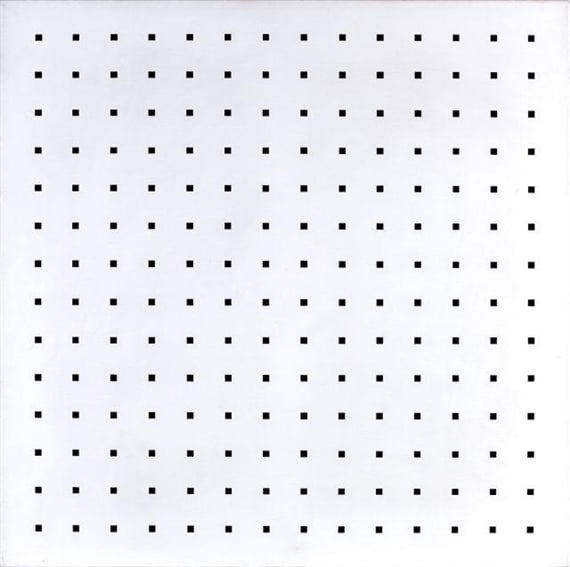
Aurelie Nemours’ Rythme du millimètre (Rhythm of the Millimeter) is a quintessential work of Concretism, a movement that championed absolute abstraction, mathematical precision, and the rejection of any narrative or emotional reference. The painting belongs to the abstract genre, but its significance lies in how it radicalizes abstraction through an almost obsessive attention to measurement and order.
Formal and Structural Significance
The title itself is a manifesto: “rhythm” implies movement and pulse, while “millimeter” invokes the smallest unit of measurable space. Nemours reduces painting to a system of exact, repeatable intervals. The work typically consists of a monochrome or limited palette (often black, white, and primary colors) arranged in a strict grid or banded pattern. These bands—usually vertical or horizontal—are spaced with rigorous, consistent margins, each line or gap calculated to the millimeter. The result is a visual “beat” that feels both mechanical and meditative.
Concretist Principles in Action
Unlike Abstract Expressionism, which prizes spontaneity, or abstract geometry that allows for subjective composition, Concretism demands self-imposed rules. Nemours’ practice exemplifies this: she often created series where the only variable was the increment of the millimeter, testing how subtle shifts in spacing could alter the viewer’s perception of rhythm, weight, and spatial tension. Rythme du millimètre embodies the idea that pure form—line, color, proportion—can generate its own autonomous reality, free from representation or metaphor.
Place in Art History
Nemours was a leading figure in the Groupe de Recherche d’Art Visuel (GRAV) and later the Espace de l’Art Concret movement in France. Rythme du millimètre stands as a landmark because it takes the strictest principles of concrete art (as codified by Theo van Doesburg and Max Bill) and pushes them to an almost radical limit. By making the millimeter the unit of rhythm, she bridges the gap between the infinite smallness of measurement and the expansive field of the canvas, creating a dynamic stillness that challenges the viewer to look at structure itself.
Conclusion
The painting’s significance is not in what it depicts—it depicts nothing—but in how it makes precision and repetition the agents of visual experience. It is a pure, almost scientific exploration of space, line, and time. In Nemours’ hands, the millimeter becomes not a constraint but a generative principle, proving that the most extreme discipline can yield a surprisingly lyrical, resonant abstraction.
Visuell ähnlich
20 Werke mit ähnlicher Komposition und Farbpalette
Untitled
Henryk Berlewi
V74-63S
Herman de Vries
Costellazione
Antonio Calderara
Stupidogramm
Dieter Roth

Untitled
Enrico Castellani
Yeu de reflets
Martha Boto
Untitled
Kuno Gonschior
Serielles
Victor Bonato
Punktstruktur
Almir Mavignier
Problemi di unificazione per uguaglianza cromatica
Mario Ballocco
Atmosphère chromoplastique N° 210
Luis Tomasello
Static 2
Bridget Riley
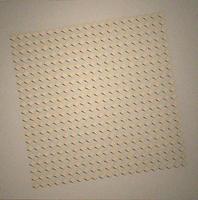
Atmosphère chromoplastique N° 342
Luis Tomasello
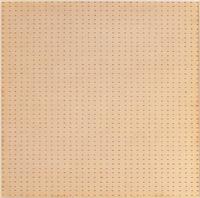
Untitled (White Flower)
Agnes Martin
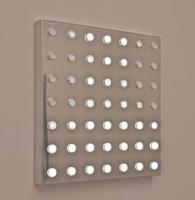
Diamond Sea (7x7)
Leo Villareal
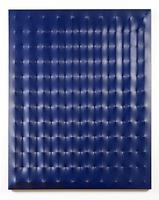
Superficie Blu
Enrico Castellani
Atmosphère chromoplastique N° 572
Luis Tomasello
Induzione cromatica (bianco, rosato, azzurrato) e formale (stratificazione alternante dischi e quadri in primo piano)
Mario Ballocco
Optical Painting
Wen-Ying Tsai
La Lumière Noire, n°700
Luis Tomasello