Expertenanalyse zu Vanessa Bells Abstract Painting
Stil: Abstract Art · Genre: abstract
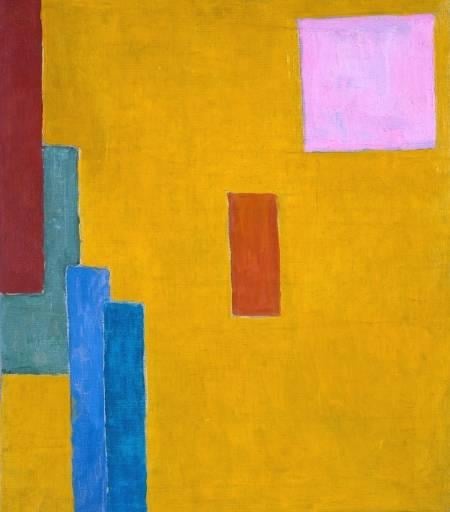
The artwork Abstract Painting by Vanessa Bell holds a distinct place in the history of early British modernism. As a core member of the Bloomsbury Group and a key participant in Roger Fry’s Omega Workshops, Bell was among the first British artists to move beyond Post-Impressionism into a purely non-representational idiom. This piece exemplifies her radical shift from figurative portraiture and still life to a vocabulary of form and color unburdened by subject matter.
Significance within Abstract Art and its Period:
-
Pioneering British Abstraction: At a time when British painting was still largely dominated by naturalism and narrative, Bell’s venture into abstraction was a bold declaration of independence. Abstract Painting stands as a testament to her engagement with the formalist theories of Clive Bell (her husband) and Roger Fry, who argued that the “significant form”—the arrangement of lines, colors, and shapes—was the essence of art. This work puts that theory into practice, creating an aesthetic experience driven purely by visual harmony.
-
Bloomsbury and the Omega Workshops: Painted in a style closely aligned with the decorative and rhythmic experiments of the Omega Workshops (c. 1913–1919), this painting likely dates from the mid-1910s to early 1920s. Bell uses layered, intersecting planes of color—reminiscent of Cubist fractured space but softened by a lyrical, Post-Impressionist palette. The work is not a rigid geometric abstraction; instead, it retains a sense of organic movement and improvisation, reflecting the Bloomsbury ideal of art as a natural extension of life and decoration.
-
Influence of French Modernism: Bell’s abstraction draws heavily on the color theories of Henri Matisse and the spatial inventions of Pablo Picasso, yet it filters them through a distinctly British sensibility—more restrained in its chromatic fervor but equally committed to the autonomy of the painted surface. The painting likely features muted earth tones punctuated by small areas of bright pigment, a hallmark of Bell’s mature abstract period.
-
Gender and Artistic Recognition: As a female artist within a male-dominated avant-garde, Bell’s abstract works are particularly significant. While her contemporaries like Duncan Grant and Roger Fry also practiced abstraction, Bell’s contribution has often been overshadowed by her domestic and portrait works. This painting asserts her place as a serious innovator in non-objective art, demonstrating that her forays into abstraction were not secondary experiments but fully realized contributions to the modernist canon.
Artistic Impact:
In Abstract Painting, Vanessa Bell achieves a delicate balance between structure and spontaneity. The composition is likely built from interlocking biomorphic and geometric shapes—curving segments, tilted rectangles, and rounded forms—that pulse with a quiet, rhythmic energy. There is no single focal point; instead, the eye is invited to travel across the canvas, discovering relationships of hue and texture. The painting’s significance lies not in what it represents but in how it makes the viewer feel the internal logic of its forms. It stands as a crucial document of British modernism’s embrace of abstraction, illuminating Bell’s role as a fearless explorer of pure visual language at a time when such experiments were still radical.
Museum / Gallery
Visuell ähnlich
20 Werke mit ähnlicher Komposition und Farbpalette
Composition
Marthe Donas
Orange, Black and White Composition
William Scott
Untitled
Lothar Charoux
Silent Night
Hans Hofmann
No. 19
Mark Rothko
18.6.65
John Hoyland
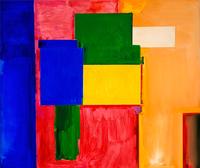
To Miz - Pax Vobiscum
Hans Hofmann
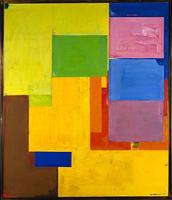
Veluti in Speculum
Hans Hofmann
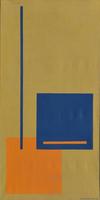
Geometric Shapes in Space
Nadia Khodossiévitch-Léger
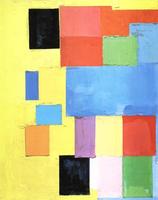
Pastorale
Hans Hofmann
Untitled
Tomas Maldonado
1924 (first abstract painting, Chelsea)
Ben Nicholson
Composition No. 204
Friedrich Vordemberge-Gildewart
Grata nera blu cobalto oltremare Parigi
Mario Ballocco
Picturial Architecture
Lajos Kassak
Abstract Euphony
Hans Hofmann
No. 9
Mark Rothko
Untitled
Ilse D'Hollander
Exercise II
Félix Del Marle
Planar Tension with Red
Willi Baumeister