
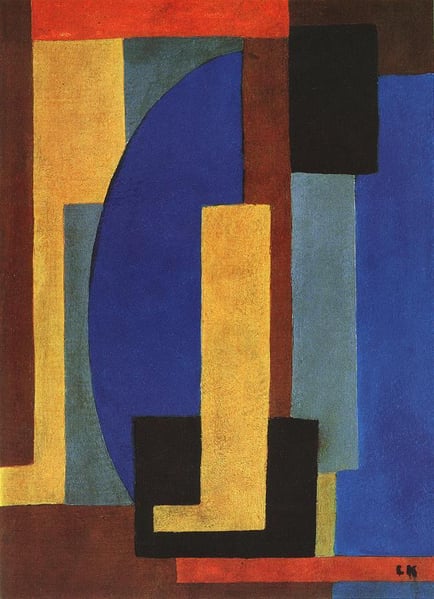
Expert analysis of Lajos Kassak’s Picturial Architecture
Style: Constructivism · Genre: abstract
Expert Analysis of "Picturial Architecture" by Lajos Kassak
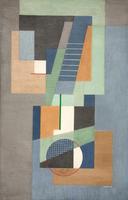
As a work of Hungarian Constructivism, Lajos Kassak’s “Picturial Architecture” stands as a key example of the movement’s ambition to synthesize art with the functional and spatial logic of modern life. Though strictly abstract, the title itself signals a core Constructivist concern: the translation of architectural principles—structure, balance, materiality—into painterly form. Kassak was a central figure in the Hungarian avant-garde, and this piece likely embodies his “picture-architecture” concept, where geometric shapes (circles, rectangles, lines) are arranged not as decorative motifs but as dynamic, almost tectonic elements that propose a new visual order.
Significance within Constructivism and its Period:
-
Bridging Abstraction and Utilitarianism: Constructivism rejected mere aesthetic pleasure in favor of art as an active agent in social and industrial transformation. “Picturial Architecture” literalizes this mission by treating the canvas as a blueprint for a new environment—an abstracted plan for a future built world. Kassak’s composition would have been conceived as a model for spatial organization, echoing the movement’s desire to erase the boundary between easel painting and applied design.
-
Kassak’s Role as a Pioneer: As the editor of the influential avant-garde journal MA (Today), Kassak helped disseminate Constructivist ideas across Central Europe. His own abstract works, such as this one, are significant for their rigorous, non-objective vocabulary—they reject mimetic representation entirely, using pure form and color to articulate a universal visual language. “Picturial Architecture” exemplifies this radical shift, placing Kassak alongside peers like El Lissitzky and László Moholy-Nagy in the quest for a “constructive” art.
-
Dialogue with Architecture: The title explicitly links painting to building. For Constructivists, art should be “built” like a machine or a building: precise, efficient, and grounded in real materials. In “Picturial Architecture,” Kassak likely orchestrates a tension between flatness and depth—a hallmark of Constructivist painting—where overlapping planes and directed lines suggest structural forces rather than illusory space. This approach prefigures later developments in geometric abstraction and minimalism.
In summary, “Picturial Architecture” is significant because it distills Constructivist ideology into a pure abstract image, asserting that painting can function as a prototype for a new, rational, and socially engaged environment. Kassak’s work here is not just an art object; it is a manifesto in form.
Visually similar
20 works with related composition and palette
Planar Tension with Red
Willi Baumeister
Abstract 5
René Marcil
Peinture murale (Mural Painting)
Fernand Leger
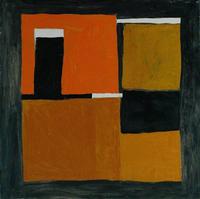
Orange, Black and White Composition
William Scott
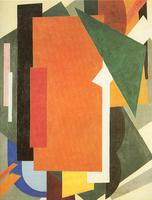
Architectonics in Painting
Lyubov Popova
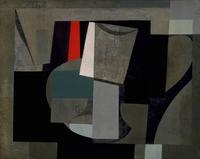
1934-6 (painting - still life)
Ben Nicholson
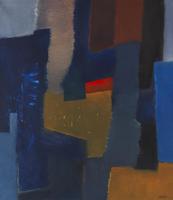
Vertikal 2
Fritz Winter
Composition
Hryhorii Havrylenko
Abstract Painting
Vanessa Bell
Composition
Marthe Donas
Untitled
Lothar Charoux
Ventana al infinito
Carlos Merida
Exercise II
Félix Del Marle
Composizione
Atanasio Soldati
Composition
Lajos Kassak
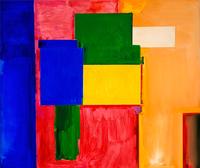
To Miz - Pax Vobiscum
Hans Hofmann
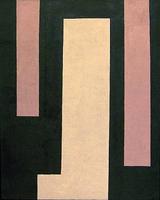
Untitled (April 15)
Myron Stout
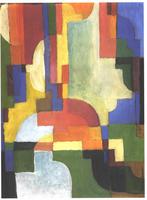
Colourful Shapes
August Macke
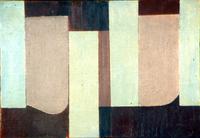
Composition 3
Stefan Sevastre
Geometric Composition
Toyen