Analisi esperta di Clandestine Game XI di Omar Rayo
Stile: Op Art · Genere: abstract
Expert Analysis of Clandestine Game XI by Omar Rayo
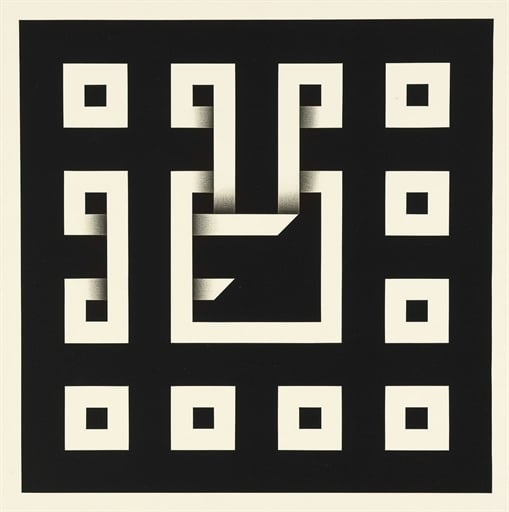
Omar Rayo’s Clandestine Game XI stands as a masterful example of Op Art’s core ambition: to destabilize perception through rigorous geometric abstraction. As a leading figure in Latin American Op Art, Rayo transformed the movement’s international language into a deeply personal exploration of visual trickery and hidden order.
Significance within Op Art
- Optical tension and concealed geometry: True to the series title, this work employs a lattice of repeated, interlocking forms—often resembling stepped prisms or folded ribbons—that shift between positive and negative space. The eye is drawn into a calculated game of figure-ground reversal, where what appears solid suddenly becomes void, and vice versa. This pushes Op Art beyond mere retinal stimulation into a conceptual “game” that challenges the viewer’s trust in stable form.
- Rhythm and counterpoint: Rayo’s precise alternation of black, white, and intermediate grays (or vivid complementary hues in other versions) generates a pulsating moiré effect. Unlike some Op artists who rely on aggressive visual assault, Rayo’s rhythms are measured and almost architectural, inviting contemplation rather than disorientation. The “clandestine” quality lies in how the pattern gradually reveals hidden sub-patterns—a truly active viewing experience.
Rayo’s unique contribution
- Latin American modernism: While Op Art flourished in Europe and the United States, Rayo infused it with a distinct sensibility drawn from pre-Columbian textile patterns and indigenous geometry. Clandestine Game XI echoes the repetitive, modular designs of Andean weavings, transformed into a kinetic, machine-age aesthetic. This synthesis made Rayo a pivotal figure in bridging international modernism with Latin American visual heritage.
- Art as perceptual investigation: The work exemplifies Op Art’s philosophical engagement with how we construct reality. By making the painting’s structure both explicit and elusive—a game with hidden rules—Rayo asserts that abstract art can destabilize habitual seeing, revealing the act of perception itself as a creative, and sometimes deceptive, process.
In Clandestine Game XI, form is never static; it oscillates, folds, and conceals. This is not just a decorative optical trick but a rigorous investigation into the very mechanics of looking—a hallmark of the finest Op Art.
Visivamente simili
20 opere con composizione e palette affini
Sararas XX
Omar Rayo
Palindrome 10
Omar Rayo
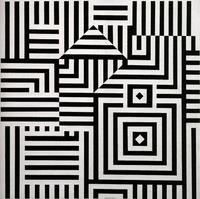
Riu-Kiu-C
Victor Vasarely
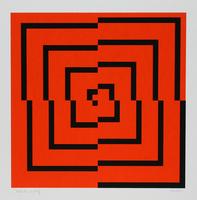
Espiral Laranja
Rubem Ludolf
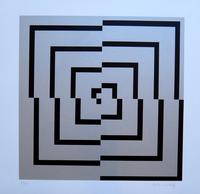
Espiral Prata
Rubem Ludolf
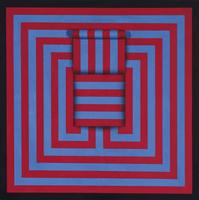
Witoto
Omar Rayo
Hidden Rainbow x9
Yaacov Agam
Myrina
Piero Dorazio
Verzerrt und gespiegelt
Max Coor
Untitled
Rubem Ludolf
Study for Variant
Josef Albers
Condition
Peter Halley
Saphan
Omar Rayo
Geometrische Komposition
Verena Loewensberg
Fortín de las Flores
Frank Stella
Vitreaux Cinétique III
Gregorio Vardanega
Vitreaux Cinétique III 1973
Gregorio Vardanega
Untitled
Luis Sacilotto
Compenetrazione quadrangolare di due ordini di chiarezze di tonalità nm 498 ca. (blu) e 587 ca. (ocra)
Mario Ballocco
Série Mangueira
Ivan Serpa