Экспертный разбор работы «La danseuse et les deux pigeons» художника Jean Dupas
Стиль: Art Deco · Жанр: genre painting
Expert Analysis of La danseuse et les deux pigeons by Jean Dupas
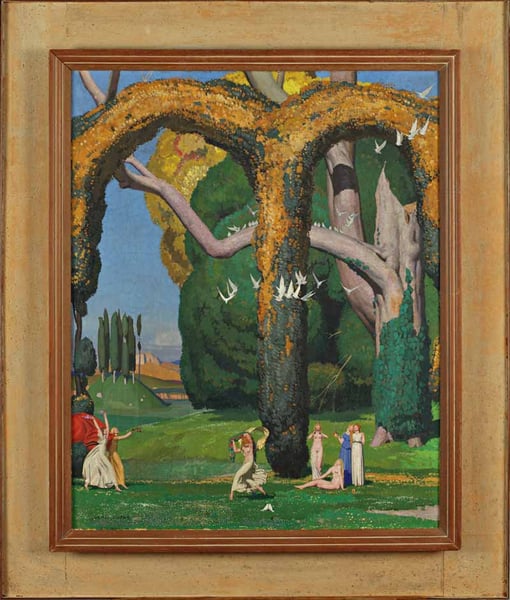
Jean Dupas’s La danseuse et les deux pigeons (The Dancer and the Two Pigeons) stands as a paradigm of Art Deco painting—a style that dominated the decorative and fine arts of the 1920s and 1930s. The work is a genre painting, but one that elevates a contemporary, theatrical subject into a timeless, stylized vision of grace and luxury.
Significance within Art Deco
Dupas was a central figure in the Art Décoratif movement, celebrated for his murals at the 1925 Exposition des Arts Décoratifs (the event that gave Art Deco its name). His work embodies the movement’s core principles: sleek geometry, polished surfaces, and a fusion of classical idealism with modern sophistication. In this painting, the dancer’s elongated, sinuous silhouette and the poised pigeons reflect the period’s fascination with slow, deliberate movement and elegant formalism—a stark contrast to the jarring dynamism of Futurism or the emotional rawness of Expressionism.
Thematic and Compositional Significance
The title evokes the famous Fable of The Two Pigeons by La Fontaine, but Dupas transforms the narrative into a visual celebration of harmony between human and nature, performance and tranquility. The dancer (likely a ballet or cabaret performer) is rendered with the cool, smooth contours typical of Art Deco’s linea pura (pure line). The pigeons, traditional symbols of love and peace, are integrated into the composition with a decorative precision that echoes the patterns of contemporary jewelry, textiles, and lacquer work.
- Genre painting reimagined: Rather than a moralizing or anecdotal scene, Dupas uses the genre as a vehicle for pure decoration. The flat, shallow space and rhythmic arrangement of forms prioritize pattern over depth—a hallmark of Art Deco’s debt to Cubism’s fractured planes and Orientalist ornament.
- Materiality and finish: Though we have only the title and stylistic designation, Dupas typically employed tempera, oil, or pastel with a matte, velvety finish that mimics fresco or enamel. The likely cool color palette of greys, ivories, silver, and muted blues reinforces the chic, urban luxury that defined Art Deco.
Cultural and Historical Position
Dupas’s work represents the “moderne” ideal of the Années Folles (the Roaring Twenties): a world of jazz, champagne, and streamlined glamour. La danseuse et les deux pigeons is significant because it bridges high art and commercial design. The same compositional logic could be found on a Sèvres vase, a Lalique glass panel, or a poster for the Ballets Russes. In this sense, the painting is not just a genre scene but a manifesto of Art Deco’s belief that artistic excellence should permeate everyday life—from the stage to the sitting room.
Conclusion
La danseuse et les deux pigeons by Jean Dupas is a masterclass in controlled elegance. Its significance lies in how it synthesizes classical grace with Art Deco’s cult of the modern line, transforming a simple genre motif into an icon of interwar sophistication. For historians, it exemplifies the movement’s ultimate ambition: to make the ordinary extraordinary through perfect, decorative balance.
Визуально похожие
20 работ с близкой композицией и палитрой
The Judgement of Paris
Jean Dupas
Nymphs in a Romantic, Garden
Salvador Dali
Autumn Oaks
Grant Wood
Michaelmas Landscape
Paul Nash
"Daphnis and Chloe" set design
Leon Bakst
Autumn: The Fruit Pickers
Pierre Bonnard
View of the Fortifications
Henri Rousseau
Quatre amours dans les fleurs
Andre Bauchant
Kiss the Earth
Nicholas Roerich

Untitled (River and Hills)
Georges Ribemont-Dessaignes

Sandling Park, Kent
Paul Nash
The Grove
Andre Derain
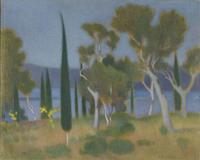
Landscape
Konstantinos Parthenis
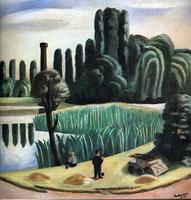
Seascape with poplars
Max Beckmann
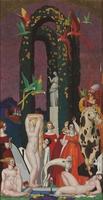
La Femme à L'Ara
Jean Dupas
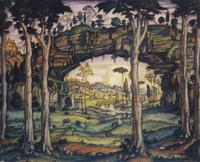
Italian Landscape
Konstantin Bogaevsky
The new generation
Jan Toorop

Walking in the Parc des Buttes Chaumont
Henri Rousseau
Rising of the moon
Wassily Kandinsky
The Tree
Henri Le Fauconnier