Otto Gustav Carlsund sanatçısının VINSKÖRD eseri hakkında uzman analizi
Tarz: Purism · Tür: genre painting
Analysis of "VINSKÖRD" (Grape Harvest) by Otto Gustav Carlsund
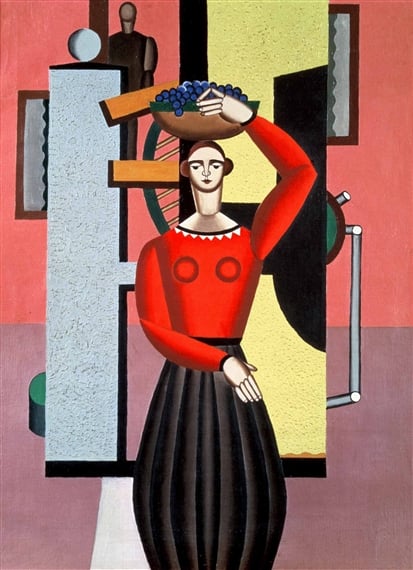
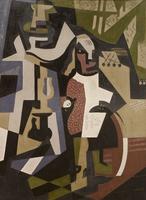
Otto Gustav Carlsund’s VINSKÖRD stands as a rare and compelling synthesis of Purist aesthetics with the traditional genre of rural labor. Created during the height of Purism’s influence (c. 1920s), the work exemplifies Carlsund’s commitment to the movement’s core tenets—clarity, precision, and the celebration of machine-like order—while departing from Purism’s typical urban or industrial subject matter. Instead, Carlsund applies the movement’s formal vocabulary to a timeless agrarian scene: the grape harvest.
Purist Principles in a Genre Setting
Purism, developed by Le Corbusier and Amédée Ozenfant, demanded that art be stripped of decorative excess and Cubist fragmentation, favoring simplified geometric forms, clean lines, and a restrained palette. VINSKÖRD translates this into a composed, almost architectural arrangement of figures and landscape. The harvesters are reduced to cylindrical, faceted volumes—bodies like machine parts—set against a landscape of terraced vineyards rendered as stacked planes. There is no romanticism; instead, the work emphasizes structure and rhythm. The repetition of basket shapes, arm angles, and vine rows creates a visual cadence that mirrors the repetitive, efficient labor of harvesting.
Significance within Carlsund’s Oeuvre and Purism
Carlsund studied directly under Ozenfant and Le Corbusier, becoming one of the few Swedish artists fully immersed in Purism. VINSKÖRD is significant because it expands Purism’s range beyond the still life and the machine. By taking a genre scene—an everyday agricultural activity—Carlsund argues that Purist logic can discipline any human activity, even one tied to nature and tradition. The painting thus bridges the avant-garde’s fascination with modernity and the timelessness of rural life, suggesting that the same economy of form governs the winemaker’s work as the factory floor.
The work also demonstrates Carlsund’s ability to flatten space into overlapping, shallow planes—a Cubist inheritance reconfigured through Purist clarity. Color is subdued, favoring ochres, greens, and greys, with local touches of grape-hued purple. This restraint reinforces the sense of order and control.
Why It Endures
VINSKÖRD is a key example of Purism’s brief but influential lifespan (c. 1918–1925). It shows how a movement deeply rooted in industrial modernism could absorb a genre with centuries of artistic tradition—from Bruegel to Millet—and reimagine it as a study in pure form. For Carlsund, it represents his most successful balance of avant-garde geometry and humanist subject matter. Today, the work is prized for its rarity: few Purist paintings treat labor with such detached dignity, and fewer still set that labor in a vineyard rather than a factory.
Stil
Görsel olarak benzer
İlişkili kompozisyon ve renk paletine sahip 20 eser
Pierrot
Juan Gris
Girl With Skipper
Mikuláš Medek

The two women bouquet
Fernand Leger
Děvče s košem
Josef Capek
Couple
Alexander Bogen
The Reader
Juan Gris
study #052
Toshihiko Okuya

The Woman and the child
Fernand Leger
Men in the city
Fernand Leger
Seated Woman
Maria Blanchard
New Immigrants
Alexander Bogen
Girl in the Country
Kazimir Malevich

Swimmers on the Ladder
Willi Baumeister

La Toilette
Alberto Magnelli
Three Girls
Kazimir Malevich
Torso
Kazimir Malevich
Femmes De San Giminiano
Leopold Survage
The Сity
Fernand Leger
Composición Con Personaje
Maria Blanchard

Acrobats in the circus
Fernand Leger