
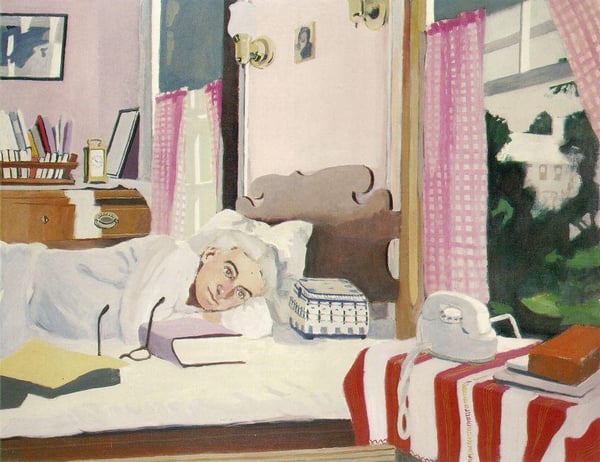
Expertenanalyse zu Fairfield Porters July Interior
Stil: Contemporary Realism · Genre: interior
Expert Analysis of "July Interior" by Fairfield Porter
Within the context of Contemporary Realism—a movement that emerged in mid-20th-century America as a counterpoint to the dominance of Abstract Expressionism—Fairfield Porter’s July Interior stands as a quietly radical affirmation of everyday life. The work is an interior genre scene, yet it transcends mere domestic record-keeping through its fusion of direct observation with a sophisticated, painterly handling of light and color.
Significance within Contemporary Realism
Porter’s commitment to representing recognizable, often vernacular spaces—here, a sunlit room in July—aligned him with a strain of realism that refused the emotional bombast and non-objectivity of the prevailing avant-garde. Unlike the heroic abstraction of his peers, Porter embraced the intimate, the domestic, and the transient. July Interior exemplifies this by rejecting narrative drama in favor of a distilled stillness: the play of warm summer light across floors, furniture, and perhaps a figure is the true subject. This focus on perceptual truth—the way light modifies color, the way a room feels at a particular time of year—places Porter in dialogue with earlier intimists like Édouard Vuillard, but updated through a distinctly American, mid-century sensibility.
Genre and Approach
The interior genre allows Porter to explore the boundary between the private and the pictorial. In July Interior, the room is not merely a setting but an active participant—its walls, windows, and objects become a canvas for color relationships that feel both natural and deliberately composed. Porter’s brushwork is loose yet controlled, and his palette—likely keyed to the warm tones of summer—conveys a sense of overheated stillness that is characteristic of his finest interiors. This is realism not as documentary, but as a meditation on perception itself: how we see, what we remember, and how light transforms the ordinary into something resonant.
Why This Work Matters
July Interior matters because it quietly insisted that the everyday—a chair, a window, a patch of sunlight—deserves the same seriousness as any grand theme. In doing so, Porter helped legitimize a contemporary realism that could be both modern and accessible, deeply personal yet universal. The painting’s significance lies in its demonstration that abstraction’s expressive power could be matched by the subtlest observation of the real world, making it a key touchstone for later generations of representational artists who sought meaning in the familiar.
Visuell ähnlich
20 Werke mit ähnlicher Komposition und Farbpalette
Willie Gillis New Year's Eve
Norman Rockwell
Untitled
Paul Ranson
The Bed in the Mirror
Henri Matisse
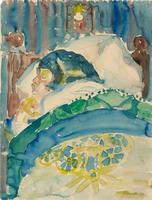
Woman in bed (Sleeping girl)
Walter Gramatté
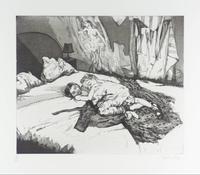
Mist IV
Paula Rego

The Arrangement
Haddon Sundblom
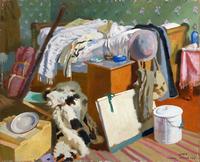
My Work Room, Cassel
William Orpen
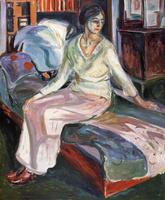
Model on the Couch
Edvard Munch

Great American Nude
Tom Wesselmann

Sleeping girl II
Walter Gramatté

Untitled
Vincent Giarrano
Resting in Bed
James McNeill Whistler
Summer Interior
Edward Hopper

Laid down woman, sleeping
Felix Vallotton

Mrs Green
Richard Eurich

Chambered Nautilus
Andrew Wyeth
Desdemona
Rodolfo Amoedo

Portrait of Sra. Dona Elena Flores de Carrillo
Diego Rivera
The Nights of Straparola
Edward Robert Hughes

Convalescent (aka Petit Dejeuner; note in opal)
James McNeill Whistler