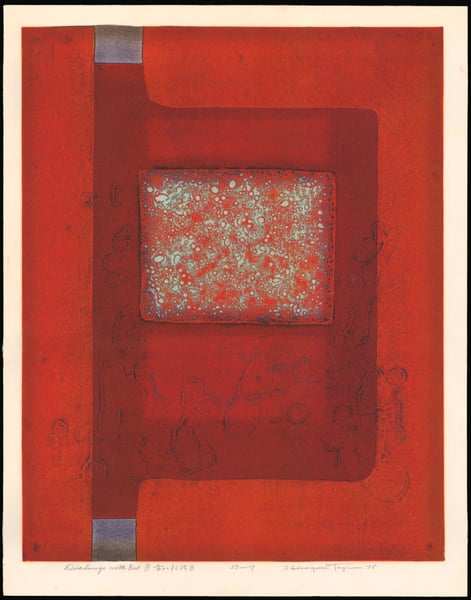
Expert analysis of Hiroyuki Tajima’s Dialogue With Red (B)
Style: Sōsaku hanga · Genre: abstract
Analysis of "Dialogue With Red (B)" by Hiroyuki Tajima
Hiroyuki Tajima’s Dialogue With Red (B) is a significant work within the Sōsaku hanga tradition, a 20th-century Japanese print movement that radically redefined the role of the artist. Unlike the earlier ukiyo-e model, which divided labor among designer, carver, and printer, Sōsaku hanga demanded that a single artist execute every step—from conception and carving to printing. This ethos of complete creative control is central to the work’s importance.
Stylistically, the piece is abstract, a bold departure from the representational norms of classical Japanese printmaking. By adopting abstraction, Tajima aligns Sōsaku hanga with global modernist currents, particularly Western Abstract Expressionism and Color Field painting. The title Dialogue With Red (B) suggests a focused exploration of chromatic interaction, likely placing red in tension or harmony with other forms and hues. This underscores the movement’s emphasis on personal expression, emotional resonance, and the physical act of printing as a direct extension of the artist’s hand.
Within the Sōsaku hanga context, Tajima’s choice of abstraction is significant because it demonstrates how the movement evolved beyond its early figurative roots to embrace pure form and color as vehicles for meaning. The “dialogue” in the title hints at a conversation between the artist, the material (woodblock and ink), and the viewer—a hallmark of the self-printed, handcrafted ethos. By foregrounding the subtractive carving process and the layered application of pigment, Dialogue With Red (B) embodies the core Sōsaku hanga principle: the print is not a reproduction but an original, autonomous artwork. Its significance lies in how it synthesizes Japanese craft tradition with the international language of abstraction, asserting the print as a powerful medium for modernist inquiry.
Visually similar
20 works with related composition and palette
Nontitle 2
Hiroyuki Tajima
Volcanic Rocks B
Hiroyuki Tajima
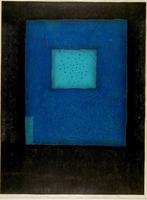
Nostalgia in Blue
Hiroyuki Tajima
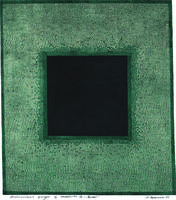
Numbers Chronos
Oleksandr Aksinin
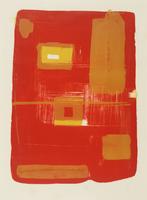
Red and Yellow Image
Patrick Heron
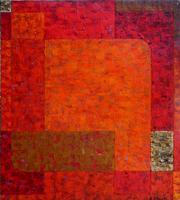
Composition abstraite
Alexandre Istrati
Uncle Up
Robert Ryman
Untitled
Antonio Palolo
Oriental Wall
Hiroyuki Tajima
Matrix - Family Album Series, n.2
Bracha L. Ettinger
White Square
Al Held
Kompozycja architektoniczna
Wladyslaw Strzeminski
Copper field
Giovanni Morassutti
"Untitled"
Kosakov Dimitrij
Impression of Small Monument
Hiroyuki Tajima
House on the Water
Paul Klee
Untitled
Alexandre Istrati
Homage to David Smith
Pat Lipsky
Homage to the Square
Josef Albers
Square
Hiroyuki Tajima