
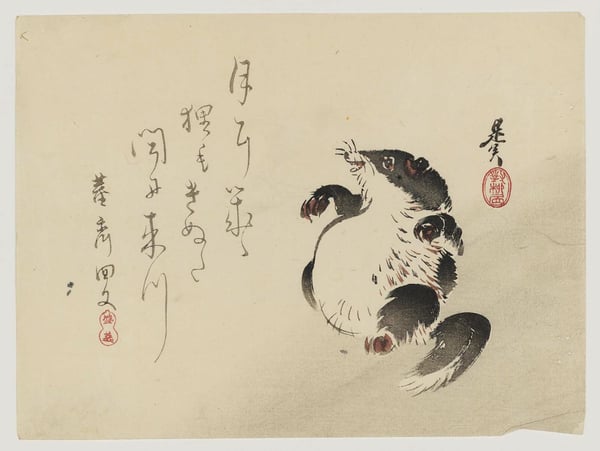
Racoon-dog (Tanuki)
Shibata Zeshin sanatçısının Racoon-dog (Tanuki) eseri hakkında uzman analizi
Tarz: Ukiyo-e · Tür: animal painting
Expert Analysis: "Raccoon-dog (Tanuki)" by Shibata Zeshin
Shibata Zeshin’s "Raccoon-dog (Tanuki)" stands as a remarkable example of late Ukiyo-e mastery, blending the traditional woodblock print aesthetic with the artist’s unique background in lacquerware and ink painting. Zeshin (1807–1891) was a transitional figure who worked across the Edo and Meiji periods, and this animal painting reveals his deep understanding of Japanese folklore, refined brushwork, and innovative approach to composition.
Significance within Ukiyo-e and Animal Painting:
-
Subject and Symbolism: The tanuki (Japanese raccoon dog) is a beloved figure in Japanese folklore, known for its mischievous, shape-shifting nature and often depicted with exaggerated features. Zeshin captures the creature’s characteristic rotund body, sly expression, and playful demeanor, embodying both realism and whimsy. This aligns with the Ukiyo-e tradition of animating everyday life and folk motifs, but Zeshin elevates it through subtle psychological portrayal.
-
Technical Innovation: Unlike many Ukiyo-e artists who relied on bold, flat color blocks and sharp outlines, Zeshin’s training in lacquerware and ink painting (sumi-e) allowed him to introduce delicate gradations of tone, soft fur textures, and a sense of volume. His brushwork here is both fluid and controlled, giving the tanuki a tactile, almost sculptural quality. This hybrid technique—marrying the linear clarity of Ukiyo-e with the atmospheric nuance of literati painting—marks a significant evolution in the genre.
-
Context of the Late Ukiyo-e Period: By the late 19th century, Ukiyo-e was facing competition from photography and Western art. Zeshin’s work revitalized the genre by incorporating elements of Western naturalism (such as shading and anatomical accuracy) while preserving Japanese decorative sensibility. "Raccoon-dog (Tanuki)" exemplifies this synthesis: the animal is rendered with empirical observation, yet the composition retains the asymmetrical balance and negative space typical of Ukiyo-e.
-
Cultural and Artistic Legacy: Zeshin’s animal paintings are considered some of the finest in Japanese art, and this tanuki piece demonstrates his ability to invest a folkloric subject with dignity and charm. It anticipates later Japonisme influences on Western artists like Van Gogh and Whistler, who admired Zeshin’s sensitivity to material and form.
In summary, "Raccoon-dog (Tanuki)" is significant for its masterful fusion of traditional Ukiyo-e techniques with innovative brushwork and realism, its faithful yet imaginative rendering of a cultural icon, and its place as a bridge between the classical Edo period and modern Japanese art.
Stil
Görsel olarak benzer
İlişkili kompozisyon ve renk paletine sahip 20 eser
Monkey and Tortoise
Hakuin Ekaku
Hotei and Child
Sengai
Squirrel and cherries
Qi Baishi

The Monkey Is Reaching For The Moon
Hakuin Ekaku
桃枝松鼠图
Qian Xuan
Untitled
Sengai
Mouse
Xu Beihong
Mouse and Grapes
Ding Yanyong
Untitled
Sengai
Poem and Falling Cherry Petals
Shibata Zeshin
Squirrel
Ding Yanyong
Chicks
Ding Yanyong
Cat and Mouse
Huang Yongyu
Cat Playing with a Toy Butterfly
Toyota Hokkei
A monster rat from the Raigo Ajari Kaisoden
Katsushika Hokusai
White Rats
Shibata Zeshin
Puppy
Sengai
Three Friends of Winter
Bada Shanren
Hotei Wakes from a Nap
Sengai
Rabbits Under Moon
Hiroshige