Analisi esperta di Puppy di Sengai
Stile: Ink and wash painting · Genere: animal painting
Expert Analysis of Sengai’s "Puppy" (Ink and Wash Painting)
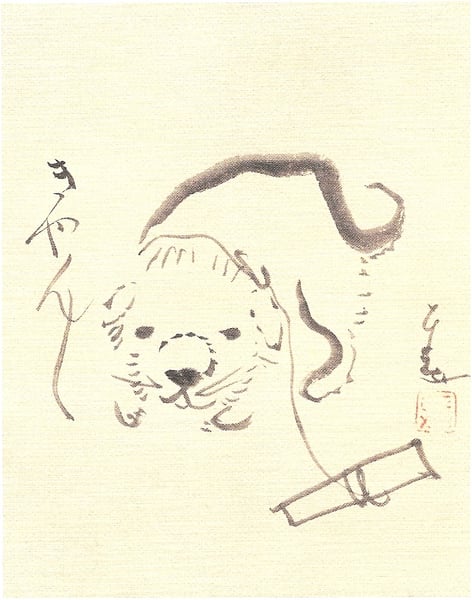
Sengai Gibon (1750–1837), a Zen monk of the Rinzai school, is celebrated for his ink paintings that distill profound Buddhist teachings into playful, seemingly simple images. His work "Puppy" exemplifies the essence of zenga (Zen painting) through its masterful economy of brushwork and its subtle philosophical depth.
Stylistic and Technical Significance
Executed in the sumi-e tradition of ink and wash, the painting achieves maximum expressiveness with minimum strokes. The puppy is rendered as a blurred, almost abstract form—a few swift, wet brushstrokes suggesting a tail, floppy ears, and a round body, with eyes that are barely indicated. This deliberate ambiguity is not a lack of skill but a hallmark of Zen aesthetics: the viewer is invited to complete the image in their mind, mirroring the Zen practice of direct, non-conceptual experience. The soft, wet ink creates a sense of spontaneity and living motion, as if the dog has just bounded into the frame.
Philosophical Context
Sengai’s animals often carry a Zen lesson. Here, the puppy embodies mushin (no-mind)—the state of unselfconscious, pure action. Unlike courtly or narrative animal paintings of the same period, this puppy is not idealized or sentimentalized; it is simply present. The painting’s roughness and informality challenge the viewer to see beyond appearances, suggesting that enlightenment is found in the mundane, the imperfect, and the fleeting.
Significance within Ink Painting
While earlier masters like Sesshū favored monumental landscapes, Sengai turned to humble subjects—cats, frogs, and puppies—with a subversive, often humorous twist. "Puppy" is significant for its radical humility: it elevates a commonplace creature to the status of a Zen koan. The work also reflects the Japanese aesthetic of wabi-sabi (beauty in imperfection) and yūgen (mysterious depth), proving that a few careless-seeming drops of ink can hold as much spiritual weight as a meticulously detailed scroll.
In the broader history of East Asian art, Sengai’s "Puppy" stands as a pinnacle of ink painting’s ability to marry simplicity with profundity—a visual haiku that continues to inspire audiences with its directness and charm.
Visivamente simili
20 opere con composizione e palette affini
Untitled
Sengai
Hotei and Child
Sengai
Camellia and Puppies in Snow
Shotei Takahashi
The Monkey Is Reaching For The Moon
Hakuin Ekaku
Cat and Butterfly
Bada Shanren
Mouse and Grapes
Ding Yanyong
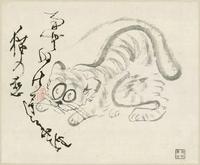
Cat (Tiger?) & poem
Sengai
Cat
Xu Beihong
Hotei
Joshu Shunso
Racoon-dog (Tanuki)
Shibata Zeshin
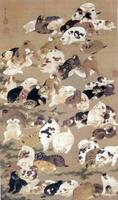
One Hundred Dogs
Ito Jakuchu
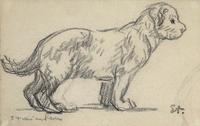
Study of a puppy
Theophile Steinlen
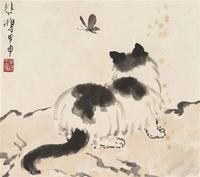
Kitten with Butterfly
Xu Beihong
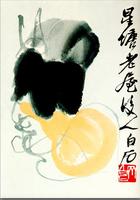
Pumpkin
Qi Baishi
Menpeki (Wall Gazing) Daruma
Soen Kogaku
Meditating Frog
Sengai
Sleeping Cat
Ding Yanyong
Cat Playing with a Toy Butterfly
Toyota Hokkei
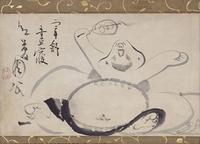
Hotei Wakes from a Nap
Sengai
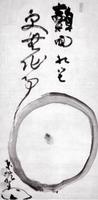
Enso (The Image Presents Itself, Nothing More)
Enji Torei