
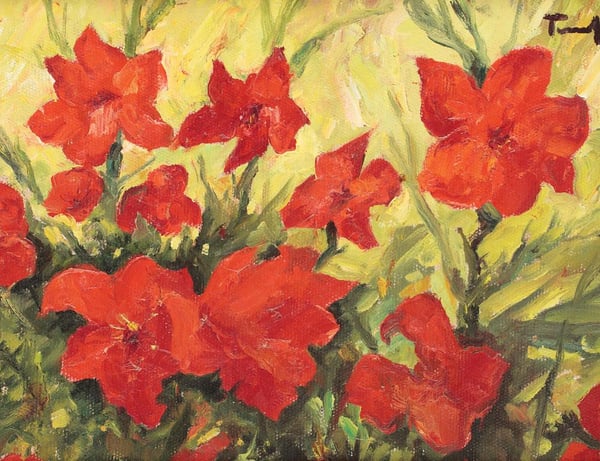
Analisi esperta di Clematis Red Flowers di Nicolae Tonitza
Stile: Expressionism, Post-Impressionism · Genere: flower painting
Expert Art Historical Analysis: "Clematis Red Flowers" by Nicolae Tonitza
Nicolae Tonitza’s Clematis Red Flowers stands as a compelling synthesis of Post-Impressionist color theory and Expressionist emotional intensity, marking a significant contribution to early 20th-century Romanian modernism. Though rooted in the traditional genre of flower painting, Tonitza transforms the subject into a vehicle for subjective expression, moving far beyond mere botanical representation.
Stylistic Fusion and Significance:
Tonitza masterfully bridges the decorative vibrancy of Post-Impressionism—seen in the bold, unmodulated reds and the flattened pictorial space—with the psychological urgency of Expressionism. The clematis blossoms are not rendered with naturalistic precision; instead, they pulsate with a saturated, almost aggressive crimson, set against a typically dark, ambiguous background. This strong tonal contrast heightens the flowers’ symbolic charge, evoking themes of passion, vitality, or even melancholy—a hallmark of Tonitza’s ability to imbue still life with emotional depth.
Compositional and Brushwork Innovation:
The painting likely employs expressive, often visible brushstrokes that define the flower petals with a sense of movement and organic energy. Tonitza avoids rigid symmetry, favoring an asymmetrical, dynamic arrangement that draws the eye upward and outward. This approach aligns with the broader Expressionist rejection of static beauty, instead prioritizing the artist’s inner response to the subject. The red clematis becomes a conduit for Tonitza’s own lyrical sensibility, rooted in the folk-art traditions of his native Romania yet refracted through a distinctly modern lens.
Placement in Tonitza’s Oeuvre and Art History:
Tonitza (1886–1940) was a central figure in the Romanian interwar avant-garde, co-founding the influential Grupat artistic and later the Societatea Arta Română. His flower paintings—particularly those of clematis and chrysanthemums—are celebrated for their ability to balance decorative allure with raw emotional resonance. Clematis Red Flowers exemplifies his signature style: a warm, sometimes somber palette, a preference for intimate, close-up compositions, and a discreet sense of melancholic introspection that sets his work apart from the more overtly joyful floral still lifes of his Western European contemporaries.
Enduring Impact:
This work’s significance lies in its demonstration of how a seemingly modest genre can become a site of modernist experimentation. Tonitza’s clematis does not merely imitate nature but reimagines it through the lens of subjective feeling, bridging the academic traditions of Romanian painting with the broader currents of European Expressionism and Post-Impressionism. It stands as a testament to his belief that even the most ordinary subject—a cluster of red flowers—could carry profound emotional and aesthetic weight.
Visivamente simili
20 opere con composizione e palette affini
Gladíolos (palmas de Santa Rita)
Anita Malfatti
Sword-Lillies
Gheorghe Petrascu
Imperial Gladiolus
Octav Bancila
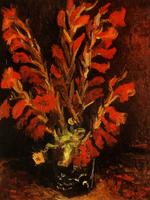
Vase with Red Gladioli
Vincent van Gogh
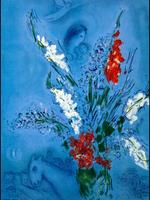
The Gladiolas
Marc Chagall
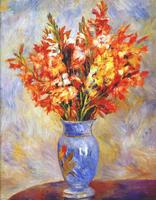
Gladioli
Pierre-Auguste Renoir
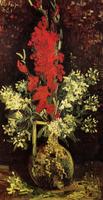
Vase with Gladioli and Carnations
Vincent van Gogh
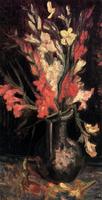
Vase with Red Gladioli
Vincent van Gogh
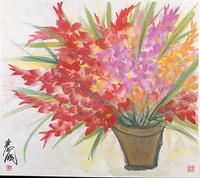
Gladioli
Lin Fengmian
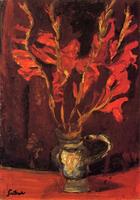
Gladioli
Chaim Soutine
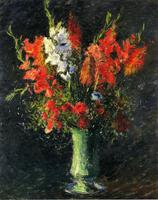
Vase of Gladiolas
Gustave Caillebotte
Gladioli
Pierre-Auguste Renoir

Gladiolen
Ivan Generalic
Untitled
Dilek Demirci
Flowers and Fruit
Pierre-Auguste Renoir

Woman with Gladioli
Charles Blackman
Still Life Flowers and Fruit
Pierre-Auguste Renoir

Still Life with Gladioli
Felix Vallotton
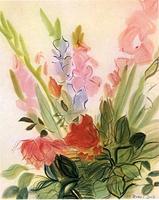
Gladioli
Raoul Dufy
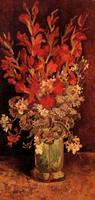
Vase with Gladioli and Carnations
Vincent van Gogh