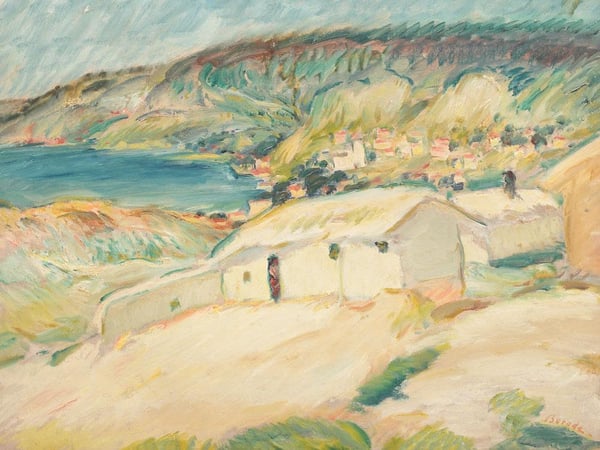
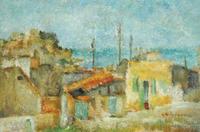
Tatar Houses in Balchik
Sever Burada sanatçısının Tatar Houses in Balchik eseri hakkında uzman analizi
Tarz: Impressionism · Tür: landscape
Expert Art Historical Analysis: "Tatar Houses in Balchik" by Sever Burada
Style: Impressionism | Genre: Landscape
Sever Burada’s “Tatar Houses in Balchik” stands as a compelling example of how Impressionist principles were adapted to capture the distinct light and cultural geography of the Black Sea coast. While the canonical Impressionists focused on the boulevards and riversides of France, Burada transports the movement’s core concerns—ephemeral light, vibrant color, and atmospheric immediacy—to an Eastern European setting, infusing the landscape with a sense of local identity and quiet ethnographic observation.
Significance within Impressionism:
-
Exporting the “En Plein Air” Ethos: The painting embodies the Impressionist commitment to working outdoors, directly observing the effects of sunlight on architecture and terrain. Balchik’s coastal light—intense, reflective off the sea, and softened by maritime haze—offers a different chromatic palette from the Seine or the Côte d’Azur. Burada’s handling of this light adds a distinct regional modulation to the Impressionist vocabulary, proving that the style was not confined to Western Europe but was a truly adaptable mode of perception.
-
Vernacular Subjectivity: The choice of “Tatar houses”—modest, whitewashed, with distinctive local architectural features—aligns with Impressionism’s preference for contemporary, everyday scenes over grand historical subjects. Yet here the “everyday” carries a cultural specificity: the Tatar community’s dwellings become a motif of peaceful coexistence and geographic character. Burada elevates a humble hillside cluster into a study of how form and atmosphere intertwine. This significance lies in the work’s ability to merge the universal Impressionist interest in transient light with a specific, non-Western locale, broadening the movement’s topical range.
-
Brushwork and Color as Narrative: True to Impressionist technique, the brushwork is likely broken and visible—short, rapid strokes that capture the shimmer of foliage, the texture of sunlit walls, and the shifting shadows cast by clouds. The color palette, one can infer, would favor vibrant whites (for the houses) contrasted with blues, greens, and warm earth tones, emphasizing the dazzling brightness of the coastal scene. Burada’s handling of these elements demonstrates that even a relatively lesser-known artist could master the stylistic hallmarks of Impressionism while contributing a fresh, localized vision.
Conclusion: “Tatar Houses in Balchik” is significant not only as a successful Impressionist landscape but as a testament to the movement’s global dispersal. It proves that Impressionism was never a monolithic school—it was a flexible language of vision, capable of rendering the unique light and cultural textures of places like Balchik as vividly as Claude Monet rendered the cliffs of Étretat or Camille Pissarro the meadows of Pontoise. Burada’s work enriches the Impressionist canon by documenting a corner of Eastern Europe with the same sensitivity to atmosphere and color that defines the movement at its best.
Tür
Stil
Görsel olarak benzer
İlişkili kompozisyon ve renk paletine sahip 20 eser
Bo-Kaap
Gregoire Boonzaier
Evening at Balcic
Francisc Sirato
Ciotat
Georges Braque
Balchik Hills
Sever Burada
Cartierul tătărăsc la amiază
Jean Alexandru Steriadi
Equinoxe à La Ciotat
Alexis Gritchenko
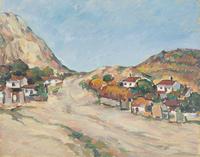
Balcic Hills
Nicolae Darascu
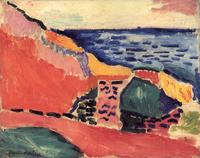
La Moulade (Collioure In The Summer)
Henri Matisse
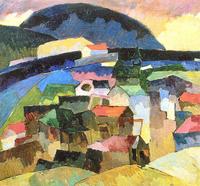
Gursuf
Aristarkh Lentulov
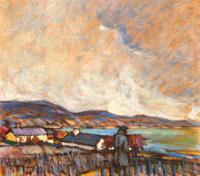
Egry József, Balatonfelvidék
Egry József
The Gulf of Marseille Seen from L'Estaque
Paul Cezanne
Gloucester
John Henry Twachtman
Egry József, Balatonfelvidék,
Egry József
Houses
Gregoire Boonzaier
Balchik Gulf
Stefan Dimitrescu
Chalet in the Mountains
William H. Johnson
Aim Of Ibiza
Joaquín Sorolla
Cassis Landscape
Lucian Grigorescu
Peisaj la Cassis
Jean Alexandru Steriadi
Balchik Landscape
Micaela Eleutheriade