Description
Stijl: Early Renaissance · Genre: sculpture
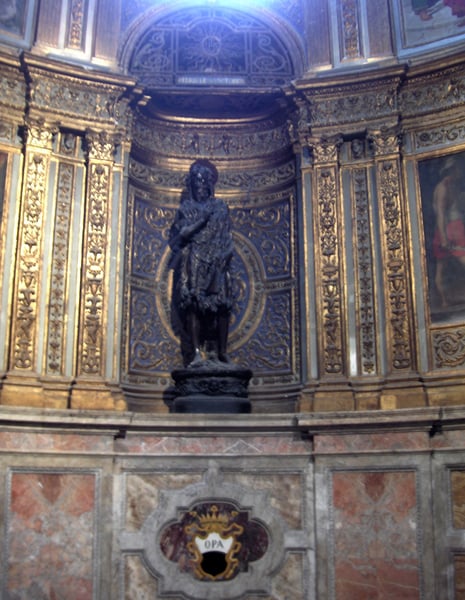
Donatello’s bronze statue Saint John the Baptist (1457) decorates the chapel dedicated to the Saint at the Siena Cathedral. In his lifetime Donatello was held in high esteem, being sought after in places outside of his native Florence, like Venice, Padua, Pisa, and Naples. In particular, the artist cultivated a special relationship with the neighboring republic of Siena, and in 1457 he declared his wish to spend the rest of his life there. Around that time, the bronze statue of Saint John the Baptist was brought to Siena, and ten years later, it was listed in the inventory of the Siena Cathedral. At its delivery, it was noted that the statue was missing its right forearm. Scholars tried to explain it in several ways. One possibility is that the sculpture was sent over to Siena in sections, to prevent damage and to manage import costs. However, local sources from the 16th century claimed that Donatello left the statue incomplete because he was never paid in full. This claim was repeated by Vasari in Lives of the Most Excellent Painters, Sculptors, and Architects published in 1568. Thus, it is possible that Donatello never actually completed the statue and that the right arm is an addition executed by an unknown artist.
Almost two decades earlier, Donatello created another sculpture of Saint John the Baptist (1438): the citizens of Florence commissioned the wooden figure for the chapel of the Florentine community in the Santa Maria Gloriosa dei Frari in Venice. In both cases, Donatello positioned the figures similarly, standing with their legs spread, their mouths open as if preaching a sermon, and a raised arm. But significant differences are evident in style and appearance. It is possible that Donatello wanted to create something unique for his Sienese clientele, to avoid comparisons to the sculpture in Frari. In the Sienese version, Donatello depicts an older man of bigger proportions, more athletic and more muscular. In contrast to the Frari figure, the statue in Siena is executed more expressively: the lines of the silhouette are no longer smooth; they are broken and jagged.
Another reason for the stylistic shift could have been that Donatello wanted to accommodate the statue to Sienese taste. Two sculptures by Sienese artists, Saint John the Baptist (ca. 1418-1423) by Domenico di Niccolo dei Cori and Saint John the Baptist (ca. 1417) by Sienese sculptor Jacopo della Quercia, share commonalities with Donatello’s statue. The Sienese artists show a prototype of Saint John that differs from Donatello’s figure in Frari, in which Saint John is presented as a hermetic saint weakened from his ascetic practices. The statues of Cori and Quercia have the same wiry and sturdy qualities found in Donatello’s bronze sculpture. This Sienese model shows a more animated and assertive type of Saint John the Baptist. Whether or not these artists influenced Donatello, the bronze figure of Saint John the Baptist is indicative of Donatello’s later style. In this period, his figures were more expressive and harnessed greater emotional intensity. Other examples of his later style include the bronze Judith and Holofernes (1457-1464) and the wooden Magdalene Penitent (1453-1455).
Visueel vergelijkbaar
20 werken met verwante compositie en kleurenpalet
St. Longinus
Gian Lorenzo Bernini
Untitled
Miguel Rio Branco
Penitent Magdalene
Desiderio da Settignano
apollo
Giambologna
130924 Cremona San Sigismondo (131)
Camillo Boccaccino
Funerary monument to Giovanni Luca Pallavicini
Giovanni Duprè
Fountain decorated with mosaic in Pompeii
Roberto Rive
Santo Stefano
Lorenzo Ghiberti
San Juan Bautista
Lorenzo Ghiberti
The Blessed Lodovica Albertoni
Gian Lorenzo Bernini
San Matteo
Lorenzo Ghiberti
Tomb of Pope Alexander VII
Gian Lorenzo Bernini
Tomb of Pope Urban VIII
Gian Lorenzo Bernini
Polyptych in Santo Spirito (Bergamo), detail
Ambrogio Bergognone
Saint Mark
Donatello
Altare in Terracotta Smaltata Di Giovanni Di Andrea Della Robbia
Giuseppe Barberis
Klosterneuburg Altar
Nicholas of Verdun
The Sibyls (Santa Maria della Pace)
Raphael
Retablo de la Sagrada Forma en la Sacristía del Monasterio de El Escorial
Juan Bernabe Palomino
Sepulchre of Matilda the Great Countess
Gian Lorenzo Bernini