Edwin Austin Abbey sanatçısının Richard, Duke of Gloucester, and the Lady Anne eseri hakkında uzman analizi
Tarz: Romanticism · Tür: literary painting
Expert Art Historical Analysis
Title: "Richard, Duke of Gloucester, and the Lady Anne"
Artist: Edwin Austin Abbey
Style: Romanticism
Genre: Literary Painting
Significance Within Romanticism and Literary Painting
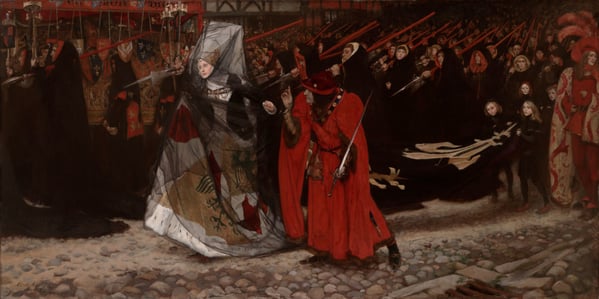
Edwin Austin Abbey’s Richard, Duke of Gloucester, and the Lady Anne stands as a quintessential example of Romantic literary painting—a genre that sought to visualize the emotional and psychological depths of great literature rather than merely illustrate narrative events. The work draws directly from William Shakespeare’s Richard III (Act 1, Scene 2), in which the deformed, manipulative Richard cunningly woos Lady Anne over the corpse of her husband (whom Richard himself has murdered). Abbey captures not the moment of argument or rejection, but the pivotal instant when Anne’s hatred begins to falter under Richard’s verbal and psychological assault—a hallmark of Romanticism’s obsession with inner conflict, moral ambiguity, and the power of emotion.
What Makes This Work Significant
-
Mastery of Psychological Drama – Abbey eschews overt violence or grand gestures in favor of a tense, intimate confrontation. Richard’s posture is a study in calculated humility: slight bow, pleading hands, and eyes that both flatter and menace. Lady Anne’s partial turn and averted gaze convey her internal struggle between righteous anger and involuntary attraction. This nuanced portrayal of shifting power dynamics is a high achievement of Romantic narrative art, prioritizing emotional truth over historical pomp.
-
Romantic Staging and Atmosphere – The setting—a dim, shadowy interior with a massive Gothic arch and funereal monument—creates a stage-like space that echoes both the play’s theatrical origins and Romanticism’s love of the sublime, the medieval, and the melancholy. The heavy contrasts of light and dark (chiaroscuro) heighten the tension, with Richard emerging from shadow while Anne is bathed in a pale, uncertain light. Every element—the carved stone, the draped cloth over the coffin, the wisp of incense—serves to immerse the viewer in a world of tragic grandeur.
-
Abbey’s Role as a Bridge Between Illustration and High Art – Edwin Austin Abbey (1852–1911) was a leading American-born painter and illustrator, best known for his meticulous historical research and his murals for the Boston Public Library and the Pennsylvania State Capitol. In this work, he elevates the literary painting from mere book illustration to a full-scale, psychologically complex composition that rivals the historical canvases of his European Romantic contemporaries. His attention to period costume, heraldry (Richard’s emblem of the white boar on his collar), and architectural detail is precise, yet never overwhelms the human drama.
-
A Defining Example of Shakespearean Romanticism – The painting belongs to a rich tradition of 19th-century artists interpreting Shakespeare (e.g., Delacroix, Fuseli, Millais). Abbey’s treatment of Richard—a charismatic villain rather than a grotesque monster—reflects Romanticism’s fascination with the antihero and the dark side of human nature. The work invites the viewer to witness seduction as a form of psychological warfare, making it a compelling study of rhetoric, power, and vulnerability that resonates beyond its literary source.
Conclusion
Richard, Duke of Gloucester, and the Lady Anne is significant not only as a technically superb Romantic literary painting but also as a masterclass in capturing a moment of profound emotional conflict. Abbey’s fusion of Shakespearean text, theatrical staging, and intimate character study marks it as a mature work that transcends period illustration. It remains a powerful testament to how Romanticism used literature as a springboard for exploring the most complex recesses of the human soul.
Stil
Görsel olarak benzer
İlişkili kompozisyon ve renk paletine sahip 20 eser
Heraldic Chivalry
Alphonse Mucha
Bruce and De Bohun
John Duncan
Henryk Pobozny
Jan Matejko
Duguesclin Cocherel
Charles-Philippe Lariviere
Vox Populi
Edmund Blair Leighton
Lifting of the Siege of Malta Besieged by the Ottoman General Mustapha, in September 1565
Charles-Philippe Lariviere
The Penance of Eleanor, Duchess of Gloucester
Edwin Austin Abbey
Mary Stuart at Crookstone
Giovanni Fattori
The Entry of Sten Sture the Elder into Stockholm
Georg von Rosen
Invasion
Konstantin Vasilyev
Ellen Terry as Lady Macbeth
John Singer Sargent
How Sir Galahad, Sir Bors and Sir Percival Were Fed with the Sanct Grael; but Sir Percival’s Sister Died by the Way
Dante Gabriel Rossetti
Illustration for Romance About The Faithful Friendship Of Amis And Amil
Artuš Scheiner
Illustration for Božena Němcová's Fairy Tales
Artuš Scheiner
Coronation of Christian IV in 1596
Otto Bache
Rea and Captives
Gustave Moreau
OSTRUD AND TELRAMUND FROM WAGNER’S LOHENGRIN
Heinrich Lefler
Within Sight of the City to Which They Went the Pilgrim's Progress
Byam Shaw
Study for "The Battle of Ascalon"
Jean Victor Schnetz
Oleg meets wizard
Viktor Vasnetsov