
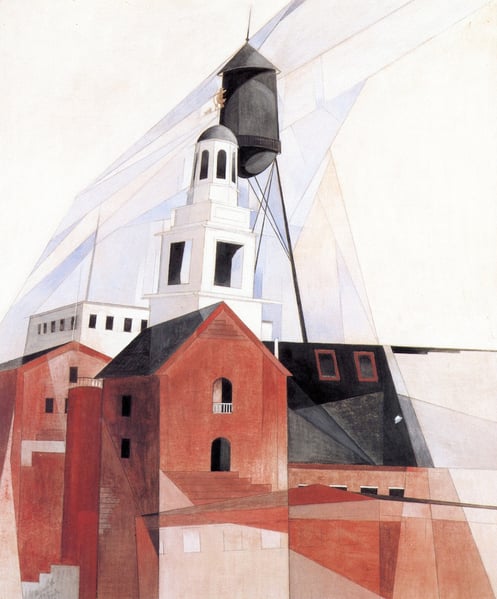
Expert analysis of Charles Demuth’s Lancaster
Style: Precisionism · Genre: cityscape
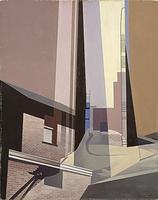
Expert Analysis: "Lancaster" by Charles Demuth
Style & Period Context
As a hallmark of Precisionism, Charles Demuth’s Lancaster (c. 1920s) embodies the movement’s core mission: to translate the raw energy of American industrialization into a controlled, geometric visual language. Precisionism flourished between the World Wars, merging Cubist spatial fragmentation with a distinctly American reverence for factory forms, grain elevators, and urban infrastructure. Demuth, along with peers like Charles Sheeler and Georgia O’Keeffe, sought to depict the modern landscape with clinical clarity—stripping away human anecdote to reveal the underlying structure of the built environment.
Significance of "Lancaster"
This cityscape is significant for its mastery of precisionist principles applied to a specific, personal locale—Demuth’s hometown of Lancaster, Pennsylvania. Unlike the anonymous industrial vistas of many contemporaries, Lancaster embeds a sense of intimate observation: the smokestacks, water towers, and factory roofs are rendered not as alien machines but as familiar, almost totemic shapes.
- Geometric Abstraction: Demuth composes the scene as a flat, interlocking puzzle of planes—roofs become trapezoids, windows form grids, chimneys rise as vertical cylinders. This abstraction pushes the cityscape toward pure form while retaining legible realism, a balance central to Precisionism’s identity.
- Color & Light: A muted, earthy palette (browns, grays, ochres) with accents of cool blue sky and white highlights creates a crisp, almost diagrammatic luminosity. This “cool precision” aligns with the style’s rejection of emotional expression in favor of objective order.
- Human Absence: The streets are empty, the windows blind. By omitting figures, Demuth transforms Lancaster into a symbol of modern efficiency—a machine-like organism functioning without sentiment. This absence was a defining trait of Precisionism, which treated the city as a monument to human engineering rather than a site of daily life.
Legacy within the Movement
Lancaster is a prime example of how Precisionism adapted European avant-garde ideas (particularly Cubism and Purism) to forge a uniquely American modernism. Demuth’s work here—alongside his iconic I Saw the Figure 5 in Gold—demonstrates that Precisionism was not merely documentary but also a form of visual poetry, finding dignity and rhythm in the industrial vernacular. In Lancaster, the ordinary becomes iconic, elevating a provincial town into a universal archetype of the modern American city.
Visually similar
20 works with related composition and palette
Aucassin and Nicolette
Charles Demuth
And the Home of the Brave
Charles Demuth
Buildings Abstraction, Lancaster
Charles Demuth

Chimney and Water Tower
Charles Demuth
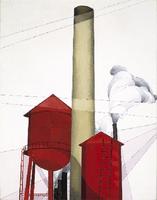
Buildings
Charles Demuth
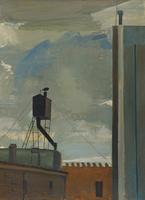
Roofs in Athens
Spyros Vassiliou

The Tower
Charles Demuth

Upper New York II
Robert Blackburn

White Architecture
Charles Demuth
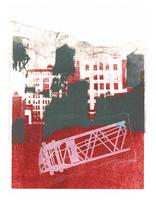
'New York City with Water Towers' No 1. - mono-print art, 2010; Dutch artist, Hilly van Eerten
Hilly van Eerten
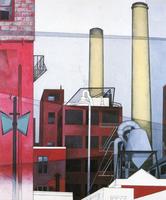
After All
Charles Demuth
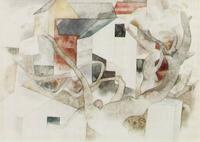
Trees and Barns Bermuda
Charles Demuth
Untitled (cityscape with twin towers)
Paul Thek
The time
Luc Tuymans

AstrTronaught
David Michael Hinnebusch
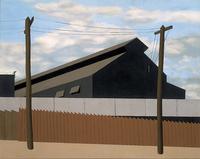
Steel Foundry, Coatesville, Pa.
Ralston Crawford

Martyr Hill
O. Louis Guglielmi

Big City
Konrad Zuse
New England Irrelevancies
Charles Sheeler

Ends Of Barns
Georgia O'Keeffe