
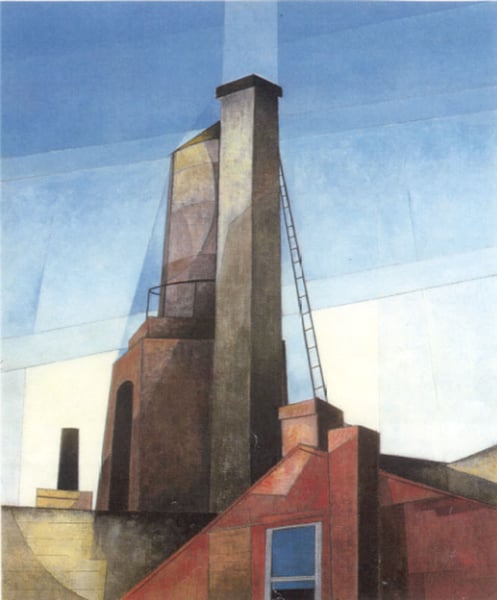
Expertenanalyse zu Charles Demuths Aucassin and Nicolette
Stil: Precisionism · Genre: cityscape
Expert Analysis of "Aucassin and Nicolette" by Charles Demuth
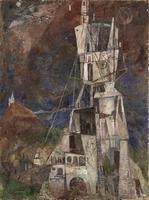
Charles Demuth’s Aucassin and Nicolette (1921) stands as a defining work of the Precisionist movement, merging a distinctly American urban landscape with a medieval literary reference. The painting exemplifies Precisionism’s core principles: crisp geometric forms, flattened planes, and an almost architectural clarity that transforms a mundane cityscape into a structured, almost abstract composition.
Significance within Precisionism: Demuth masterfully reduces a modern industrial scene—likely a factory, water tower, and smokestacks—to a series of interlocking cylinders, rectangles, and triangles. The sharp, unmodulated edges and clean lines reject the romanticism of Impressionism, instead celebrating the order and efficiency of the machine age. Yet, the title invokes a 13th-century French romance about star-crossed lovers, creating a deliberate tension between the cold rationality of modern infrastructure and the emotional narrative of a bygone era. This juxtaposition is quintessential to Demuth’s approach: he often appended literary or cultural allusions to his precise urban views, forcing the viewer to consider the interplay between past and present, emotion and structure.
Composition and Technique: Demuth employs a limited palette of muted grays, earthy browns, and soft blues, with selective areas of brighter color (perhaps a red roof or a blue sky segment) to guide the eye. The composition is tightly cropped, with forms pressing toward the picture plane, typical of Precisionism’s desire to eliminate extraneous depth. The watercolor medium—Demuth’s preferred technique—allows for translucent washes that soften the rigid geometry, adding a subtle, almost lyrical quality that tempers the hard-edged precision. This balance between exactitude and fluidity is a hallmark of Demuth’s finest works.
Cultural and Artistic Impact: Aucassin and Nicolette is significant because it demonstrates how Precisionism could infuse a purely American subject—the industrial skyline—with a sense of timeless allegory. Demuth’s ability to merge the vernacular (factories, pipes) with the universal (love, longing) distinguishes him from contemporaries like Charles Sheeler, who often focused on unembellished realism. The painting thus serves as a bridge between Cubist-derived abstraction and a uniquely American vernacular, influencing later movements from Pop Art to Neo-Precisionism. It remains a masterful example of how formal rigor can coexist with poetic allusion, securing Demuth’s place as a key innovator in early 20th-century American modernism.
Visuell ähnlich
20 Werke mit ähnlicher Komposition und Farbpalette
Lancaster
Charles Demuth
Roofs in Athens
Spyros Vassiliou
After All
Charles Demuth
New England Irrelevancies
Charles Sheeler
Buildings
Charles Demuth
Urban landscape
Mario Sironi
And the Home of the Brave
Charles Demuth

Modern Conveniences
Charles Demuth
Urban Landscape
Mario Sironi
End of the Parade, Coatesville, Pa.
Charles Demuth
Chimney and Water Tower
Charles Demuth
Factory in the Moonlight
Maximilien Luce

The anguish of departure
Giorgio de Chirico

Gasworks
Rita Angus

The Awakening of Ariadne
Giorgio de Chirico
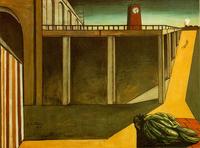
Gare Montparnasse (The Melancholy of Departure)
Giorgio de Chirico
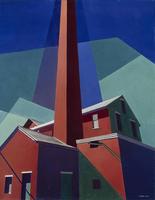
Ballardvale
Charles Sheeler
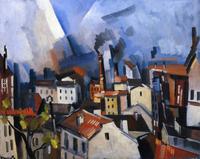
Suresnes
Maurice de Vlaminck
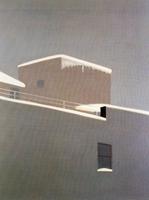
A Window In A Building
Alex Katz
Turm zu Babel
Theo Gerber