
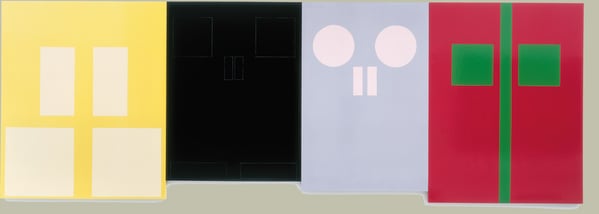
Analisi esperta di Dolphin Painting No.4 di Gary Hume
Stile: Neo-Pop Art · Genere: abstract
Expert Analysis of "Dolphin Painting No.4" by Gary Hume
Gary Hume (b. 1962) is a leading British figure in the Neo-Pop Art movement, known for his distinctive use of high-gloss household paint and his ability to distill familiar imagery into bold, flattened abstractions. "Dolphin Painting No.4" exemplifies these core concerns while demonstrating the artist’s singular approach to abstraction within a Pop-inflected vocabulary.
Formal and Technical Significance
The work is executed in Hume’s signature medium: high-gloss enamel paint on panel. This material choice creates an almost mirror-like surface, which both invites the viewer’s gaze and reflects the surrounding environment, blurring the boundary between the painted object and the real space. The dolphin motif is reduced to essential, simplified contours—curving, biomorphic shapes that hover between figuration and pure abstraction. Hume eliminates modeling, shading, and narrative detail, instead relying on crisp, unmodulated color fields and the tension between positive and negative shapes.
Neo-Pop Context and Deconstruction of Imagery
Neo-Pop Art, which emerged in the 1980s and ’90s, revisits Pop art’s fascination with mass culture and commercial imagery but often introduces a cooler, more detached conceptual irony—and a deeper engagement with formal abstraction. In "Dolphin Painting No.4", Hume takes a widely recognized popular symbol—the dolphin, associated with playfulness, nature, and entertainment—and strips it of its illustrative context. By isolating and abstracting the form, he questions how meaning is carried by visual shorthand. The dolphin becomes an icon of itself, rendered with the impersonal polish of a commercial logo yet retaining the painterly subtlety of its hand-drawn outlines.
Relationship to Hume’s Oeuvre
This work belongs to Hume’s ongoing series of dolphin paintings, which he began in the late 1990s. The series is a key example of his fascination with subjects that are simultaneously banal and evocative. The dolphin’s sleek, streamlined shape naturally suits Hume’s interest in closed, rhythmic forms. Compared to his earlier, more figural door paintings, the dolphin series pushes further into abstract territory: the animal’s body is often fragmented into disconnected arcs and voids, inviting the viewer to complete the image mentally. "No.4" likely plays with the interstitial spaces between these fragments, creating a visual puzzle that is both serene and disorienting.
Why It Matters
"Dolphin Painting No.4" is significant because it demonstrates how Neo-Pop can transcend simple replication of popular imagery and instead become a sophisticated meditation on perception, surface, and iconography. Hume’s work challenges the boundary between pure abstraction and recognizable subject matter—the painting is "abstract" in its execution, yet the title anchors it to a specific reference. This tension is a hallmark of his practice and a key contribution to contemporary painting. The work also exemplifies the Neo-Pop fascination with gloss and materiality: the reflective, candy-colored surface seduces the eye even as the simplified forms resist easy reading.
In summary, "Dolphin Painting No.4" is a quintessential Gary Hume piece—an elegant, deceptively simple abstract composition that uses the language of Pop to question representation, while celebrating the physical pleasure of paint itself.
Visivamente simili
20 opere con composizione e palette affini
Girl Boy, Boy Girl
Gary Hume
Four Squares
Stephen Antonakos
Untitled
Burgoyne Diller
Slip
Doug Ohlson
843
Funasaka Yoshisuke
833
Funasaka Yoshisuke
Untitled
Genevieve Asse
Relief, Series B
Charlotte Posenenske
Untitled II
Werner Haypeter
Untitled
Werner Haypeter
Bivest + 1
Gianni Piacentino
035 Nostalgic Daily
Genis Remacha
Black and Yellow
Carmen Herrera

Mother
R.H. Quaytman
Covenant
Frederick Hammersley
Black Forms
Ellsworth Kelly
Thira
Brice Marden
T’s China
Robert Huot
For Caroline
Brice Marden
Curved Plane Figure VIII
Robert Mangold