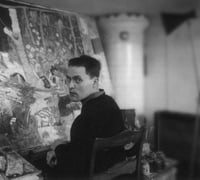
Expert analysis of Oyvind Fahlstrom’s Study for World Model (Garden)
Style: Neo-Dada, Pop Art · Genre: figurative
Expert Analysis: "Study for World Model (Garden)" by Öyvind Fahlström
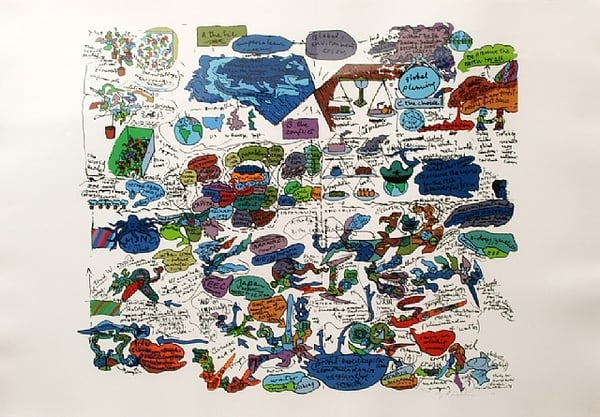
Öyvind Fahlström’s Study for World Model (Garden) stands as a pivotal work within the intersection of Neo-Dada and Pop Art, reflecting the artist’s unique fusion of political critique, playful abstraction, and systematic visual language. As a figurative piece, it distills Fahlström’s interest in modular, almost game-like compositions that critique consumer society and geopolitical power structures.
Significance within Neo-Dada and Pop Art
Fahlström was a Swedish-born artist active in New York during the 1960s, and his work occupies a critical bridge between European Neo-Dada’s ironic, absurdist tradition and American Pop Art’s engagement with mass media. Study for World Model (Garden) exemplifies his “variable” or “multiply-reproducible” approach, where elements can be rearranged or recontextualized—a concept indebted to Dadaist chance operations but refined through Pop’s graphic clarity. The “garden” motif functions as a metaphor for controlled, artificial systems (e.g., politics, economics, urban planning), juxtaposing organic growth with synthetic order. This aligns with Neo-Dada’s critique of cultural production while adopting Pop’s bright, flat, comic-strip aesthetic.
Figurative Representation and Conceptual Layering
Though figurative, the figures in Study for World Model (Garden) are deliberately schematic, almost like cut-out paper dolls or cartoon characters. Fahlström reduces human forms to interchangeable, segmented parts—heads, limbs, torsos—often laden with symbolic objects (weapons, currency, household items). This fragmentation mirrors the alienation of postwar consumer culture, a theme central to both Neo-Dada and Pop. The “world model” aspect suggests a microcosmic critique: the garden becomes a stage for power dynamics, seduction, and exchange, rendered with a playful yet unnerving detachment.
Artistic Technique and Influence
The work is likely executed in Fahlström’s characteristic mixed-media style (ink, gouache, collage, or acrylic on paper), with clean outlines and areas of flat color. His method of “variable art” influenced later conceptual and installation artists, as well as the use of diagrams and maps in contemporary political art. Study for World Model (Garden) predates and parallels the work of Roy Lichtenstein (in its comic-strip roots) and Claes Oldenburg (in its soft, organic-yet-industrial forms), but Fahlström’s insistence on systemic critique gives it a distinctly cerebral edge.
Conclusion
In Study for World Model (Garden), Öyvind Fahlström synthesizes Neo-Dada’s irreverence and Pop Art’s visual vocabulary to create a biting, layered commentary on the artificiality of modern life. Its significance lies in its ability to transform the familiar (a garden, the human figure) into a complex, open-ended system that invites the viewer to question the very structures they inhabit—a hallmark of Fahlström’s enduring relevance.
Genre
Visually similar
20 works with related composition and palette
Liberty
Jean-Michel Basquiat
Ascent
Jean-Michel Basquiat
Column no. 1 (Wonder Bread)
Oyvind Fahlstrom
Replicas
Jean-Michel Basquiat
Notes 7 ('Gook'-Masks)
Oyvind Fahlstrom
Titian
Jean-Michel Basquiat
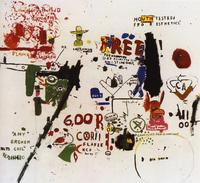
To Be Titled
Jean-Michel Basquiat
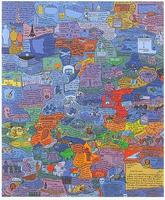
Column no. 2 (Picasso 90)
Oyvind Fahlstrom
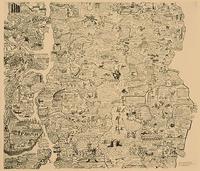
Sketch for a World map Part 1 (Americas, Pacific)
Oyvind Fahlstrom
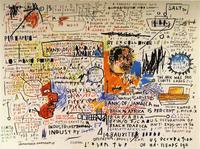
50 cent Piece
Jean-Michel Basquiat
Untitled
Alevtyna Kakhidze
Techu-Anpu
Jean-Michel Basquiat
Price of Gasoline in the Third World
Jean-Michel Basquiat
Untitled
Alevtyna Kakhidze
Monticello
Jean-Michel Basquiat
Pegasus
Jean-Michel Basquiat
Rulle (Suggestions for the Cold War)
Oyvind Fahlstrom
Snakeman
Jean-Michel Basquiat
Skin Head Wig
Jean-Michel Basquiat
Boxer Rebellion
Jean-Michel Basquiat