Expert analysis of Elmer Bischoff’s Blue Clouds
Style: Abstract Expressionism · Genre: landscape
Analysis of "Blue Clouds" by Elmer Bischoff
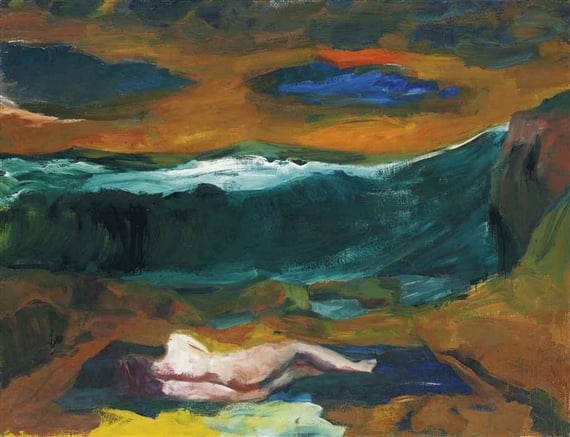
Elmer Bischoff’s Blue Clouds occupies a pivotal position within Abstract Expressionism as a landscape, demonstrating how the artist translated the movement’s emphasis on spontaneous gesture and emotional intensity into a natural subject. The work is significant for capturing a moment of transition: Bischoff, later celebrated as a leading figure of Bay Area Figurative art, here still works within the abstract idiom, channeling the raw energy of Abstract Expressionism through the motif of clouds.
The title itself suggests a departure from literal representation. "Blue" is not just a color but a psychological register—evoking depth, melancholy, or serenity—while "Clouds" imply formlessness and atmospheric flux. This tension between recognizability and abstraction is a hallmark of Abstract Expressionist landscapes, which sought to convey inner states rather than external views. Bischoff’s handling of paint likely employs broad, sweeping strokes or layered impasto, common to the style, to render clouds as dynamic, almost living entities rather than static shapes.
What makes Blue Clouds significant is its demonstration of how Abstract Expressionism could be harnessed for landscape without sacrificing the movement’s core principles: the primacy of the artist’s mark, the physicality of paint, and the evocation of sublime emotion. It stands as an important early example of Bischoff’s eventual shift toward figuration, where his abstract freedom would later inform his more representational work. In this painting, the cloud becomes a vehicle for both personal expression and a subtle nod to the natural world—a bridge between pure abstraction and the humanistic imagery that would define his mature career.
Genre
Visually similar
20 works with related composition and palette
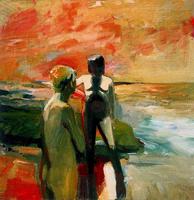
Two Figures at the Seashore
Elmer Bischoff
Belle Ile
Henri Matisse
Mondnacht Am Meer
Hermann Hendrich
Bathers
Augustus John
Vaszary János , Fekvő Akt 1919
Vaszary János
Goldau
J.M.W. Turner
The Seat at Poldu Sunset
Paul Serusier
Nude Woman on the Rocks
Odilon Redon
Moema
Rodolfo Amoedo
Reclining nude in the leaves
Moise Kisling
I Will Remember Nothing Escapes Me
Paul F. Yount
Two Bathers
Elmer Bischoff
Two Figures by the Water
Pierre-Auguste Renoir
Looking for Crabs among the Rocks, Javea
Joaquín Sorolla
Follow me, Satan!
Ilya Repin
Nude on the Grass
Pierre-Auguste Renoir
Symphony in Gray
Giovanni Boldini
After the Storm
Gustave Courbet
Boys at the beach. Study
Nikolai Ge
Komposition abfallend
Bernard Schultze