Expert analysis of Oswaldo Guayasamin’s The Cry
Style: Expressionism · Genre: portrait
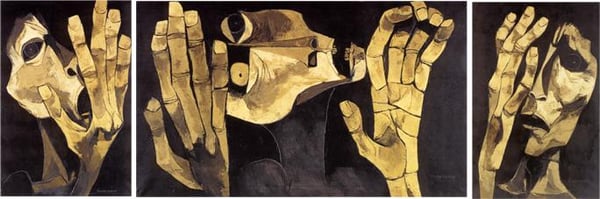
Of course. Here is an expert art historical analysis of The Cry by Oswaldo Guayasamín, based solely on the provided facts.
Artwork: The Cry
Artist: Oswaldo Guayasamín
Style: Expressionism
Genre: Portrait
Analysis:
Within the context of 20th-century Expressionism, Oswaldo Guayasamín’s The Cry stands as a powerful testament to the movement’s capacity for social and political critique. While Expressionism in Europe often focused on internal psychological angst, Guayasamín channels that same emotional intensity toward collective human suffering, particularly the trauma of colonization, oppression, and inequality in Latin America.
As a portrait, The Cry subverts traditional portraiture’s goals of likeness or idealized beauty. Instead, the face becomes a vehicle for raw, unmediated emotion. True to Expressionist principles, Guayasamín distorts the subject’s features—elongating the facial structure, sharpening angles, and exaggerating the open mouth—to create a visceral, almost primal howl. The painting’s significance lies in how it transforms a single human face into a universal symbol of anguish. The cry is not merely personal; it is historical and collective, echoing the silenced pain of entire peoples.
Guayasamín’s style is marked by bold, angular lines and a dramatic, often somber palette—likely dominated by deep browns, blacks, and stark whites or reds in this work—which heightens the sense of urgency and despair. The title itself, The Cry, functions almost as a sonic guide: the viewer is meant to hear the scream, not just see it. This aligns with the broader Expressionist goal of making emotion tangible through exaggerated form.
In the context of Guayasamín’s career, this portrait belongs to his series La Edad de la Ira (The Age of Wrath), a searing indictment of war, poverty, and injustice. Its significance within Expressionism lies in its refusal to aestheticize suffering—instead, the work demands confrontation. The Cry demonstrates how Expressionist portraiture can serve as an act of resistance, giving visual voice to the otherwise unheard. It is not a portrait of an individual, but of an era’s grief.
Visually similar
20 works with related composition and palette
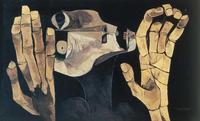
El Grito II
Oswaldo Guayasamin
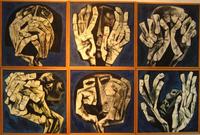
Mural
Oswaldo Guayasamin
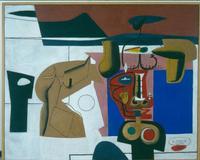
Etude pour sculpture
Le Corbusier
Pharisees
Karl Schmidt-Rottluff
Three Studies for Portrait of Henrietta Moraes
Francis Bacon
Sad Female Head
Ernst Ludwig Kirchner
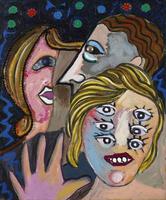
Regard multiple
Enrico Baj

Meeting at the Pentagon
Oswaldo Guayasamin
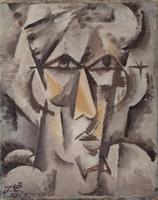
Hlava (Autoportrét)
Josef Capek
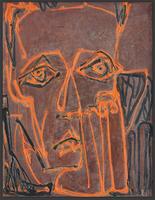
Anguish
Mykhailo Vainshtein
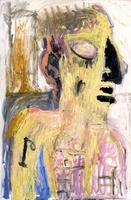
In 5 Minits You'll Know Me (sic)
Billy Childish
Portrait de femme à la cathédrale de Sens
Le Corbusier
Waiting
Oswaldo Guayasamin
Abraham
Mihnea Cernat
Wu Wei
Anthony Sims
Enlightenment of Two Sectarians
Paul Klee
Taureau
Le Corbusier
Anna MArgit Nöi Fej Pöttyös Ruhában 1947
Anna Margit
Woman with yellow hat (Jacqueline)
Pablo Picasso
Taureau XI
Le Corbusier