Analisi esperta di Chinese Beauty di Paul Jacoulet
Stile: Ukiyo-e · Genere: portrait
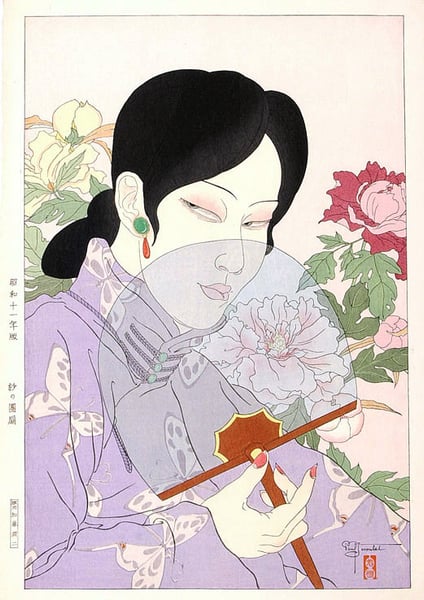
Paul Jacoulet’s Chinese Beauty is a compelling example of early 20th‑century ukiyo‑e, demonstrating how a Western artist could absorb and reinterpret a classic Japanese tradition. Created in an era when original ukiyo‑e production was waning in Japan, Jacoulet revitalized the genre by fusing its characteristic flat planes, bold outlines, and elegant patterning with a distinctly international subject matter.
Significance within the Ukiyo‑e Style:
-
Cross‑cultural dialogue: Ukiyo‑e had long depicted beauties (bijinga), but Jacoulet shifted the focus to Chinese, Korean, and other Asian figures. Chinese Beauty stands out for its respectful yet stylized portrayal of a non‑Japanese woman, reflecting the artist’s extensive travels and his desire to document the diverse faces of East Asia through a Japanese print medium.
-
Technical mastery & modern palette: Unlike the natural pigments of Edo‑period ukiyo‑e, Jacoulet used vibrant aniline dyes and Western watercolors, achieving saturated, almost luminous hues that give Chinese Beauty a striking modern freshness. His prints also feature intricate detail—such as embroidery on the garment or delicate hair ornaments—produced through meticulous hand‑carving and printing, a hallmark of his commitment to the craft.
-
Revival of the woodblock genre: By the 1930s–50s, traditional ukiyo‑e had largely given way to photography and mass media. Jacoulet’s work, including Chinese Beauty, helped sustain interest in the woodblock print as a fine‑art form, bridging the gap between the 19th‑century masters and postwar collectors. His portraits are prized for their synthesis of East Asian aesthetic ideals with a Western sensibility, making them important documents of cross‑cultural artistic exchange.
In Chinese Beauty, that synthesis is most visible in the sitter’s calm, idealized expression (a ukiyo‑e convention) combined with a three‑dimensional modeling of the face that hints at Western portraiture, all rendered with the crisp linearity and decorative flatness that define the ukiyo‑e tradition. The work thus occupies a unique place as both a homage to and an evolution of the classic bijinga genre.
Visivamente simili
20 opere con composizione e palette affini
In a Yukata
Ito Shinsui
A Corean Girl
Paul Jacoulet
Kaji of Gion holding a fan
Utagawa Kuniyoshi
Le Bocal De Poissons Rouges
Paul Jacoulet
Women
Utagawa Kuniyoshi
Lady
Lin Fengmian
Woman under a cherry tree
Utagawa Kuniyoshi
Woman selling decorative bowls
Utagawa Kuniyoshi
Women
Utagawa Kuniyoshi
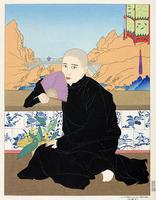
La Corbeille De Nefles. Chinois
Paul Jacoulet
Delighted- The Appearance of a Geisha Today, during the Meiji Era
Tsukioka Yoshitoshi
A Woman Holding a Fan
Ito Shinsui
Santoy
Raphael Kirchner
Dance
Utagawa Toyokuni
Domestic Scene
Kitagawa Utamaro
In a Long Undergarment (variant)
Torii Kotondo
Beautiful woman
Tsukioka Yoshitoshi
Kabuki Actor Sawamura Sojurō Iii as Ogishi Kurando
Tōshūsai Sharaku
The station Kambara
Utagawa Kuniyoshi
In a Long Undergarment
Torii Kotondo