Analisi esperta di Dans L'Isle De Tinian. Marianes di Paul Jacoulet
Stile: Ukiyo-e · Genere: nude painting (nu)
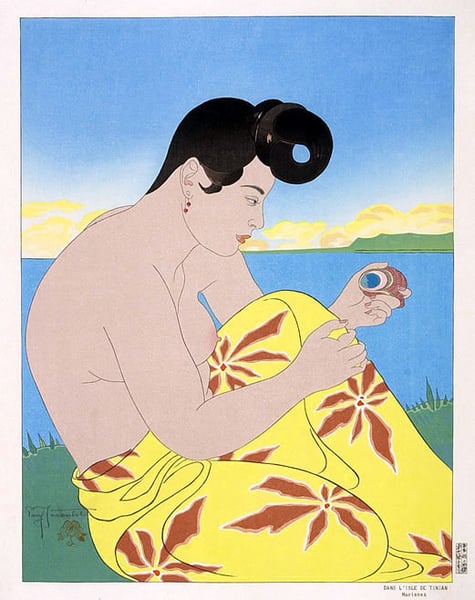
Expert Analysis: "Dans L'Isle De Tinian. Marianes" by Paul Jacoulet
Paul Jacoulet (1896–1960) stands as a singular figure in the history of ukiyo-e, bridging the traditional Japanese woodblock print with a distinctly global, 20th-century sensibility. Dans L'Isle De Tinian. Marianes exemplifies this fusion, representing a significant departure from both classical ukiyo-e subject matter and its Western counterpart in nude painting.
Within the Ukiyo-e Tradition While Jacoulet trained in the meticulous techniques of ukiyo-e—including wood carving, keyblock registration, and the use of natural pigments and embossing (gauffrage)—his choice of subject is revolutionary for the genre. Traditional ukiyo-e rarely depicted the unadorned nude body outside of explicit shunga (erotic prints) or the idealized courtesans of the floating world. Here, Jacoulet presents a full-frontal, naturalistic nude set not in a Japanese pleasure quarter but in the tropical landscape of the Mariana Islands. This shifts the focus from the social and theatrical world of Edo-period ukiyo-e to an ethnographic and sensual appreciation of the human form within nature.
Significance in the Nude Genre As a nude painting rendered in the ukiyo-e medium, this work challenges the Western tradition of the academic nude (e.g., Ingres, Manet) by using a completely non-Western visual language. Instead of the oil-on-canvas model of flesh modulated by chiaroscuro, Jacoulet uses flat, unmodulated color fields, delicate contour lines, and the texture of washi paper to define the body. The woman is not an allegorical goddess or a reclining odalisque of the Orientalist imagination; she is a specific inhabitant of Tinian, portrayed with dignity and a natural ease. The stark, pale skin tone against the lush greens and browns of the island creates a striking, almost modernist simplification—a hallmark of Jacoulet’s adaptation of ukiyo-e.
What Makes the Artwork Significant
-
Cross-Cultural Synthesis: Jacoulet is one of the few Western-born artists fully accepted into the lineage of ukiyo-e masters. His work documents peoples he encountered during his travels in the South Pacific, Micronesia, and Asia—cultures largely absent from classical Japanese prints. Dans L'Isle De Tinian functions as both an artistic print and a rare historical record of Chamorro heritage from the 1930s, before the region was heavily transformed by WWII.
-
Technical Mastery: Jacoulet’s prints are renowned for their exquisite, labor-intensive technique. He often used up to 200 separate color blocks and employed special materials like pearl dust, gold, and mica. In this piece, the subtle gradation of the sky, the precise cutting of the palm fronds, and the soft, unblemished rendering of the figure’s skin demonstrate the pinnacle of late ukiyo-e craftsmanship.
-
The Nude as Ethnography: Unlike the exoticism of earlier European painters (Gauguin, for instance), Jacoulet’s approach is more documentary. The nude is not a fantasy but an accurate portrayal of a real person in a specific location. This gives the work an ethnographic dignity rare in the genre, while still celebrating the idealized beauty of the human form through the elegant, controlled medium of ukiyo-e.
In conclusion, Dans L'Isle De Tinian. Marianes is significant because it expands ukiyo-e’s boundaries to include the international, the tropical, and the nude naturalistic—a bold reimagining of a classic Japanese art form by an artist who saw the world with fresh eyes, yet carved it with the hand of a master.
Genere
Stile
Visivamente simili
20 opere con composizione e palette affini
Woman After Bath
Goyo Hashiguchi
Combing in the Bath (variant)
Torii Kotondo
Woman After Bath
Goyo Hashiguchi
Combing in the Bath
Torii Kotondo
Woman with Scarf
Yamamura Toyonari
La Perruche Morte. Celebes
Paul Jacoulet
Fragrance of the Hot Spring
Torii Kotondo
Tokaido 53 Stations, #D
Utagawa Kunisada
Applying Powder
Torii Kotondo
Le Sculpteur De Tokobuei. Mers Du Sud
Paul Jacoulet
Calme Truck
Paul Jacoulet
Les Enfants Aux Yeux Jaunes. Ohlol, Est Carolines
Paul Jacoulet
The Fragrance of a Bath
Ito Shinsui
La Soupe Aux Huitres. Chinois
Paul Jacoulet
Awabi Pearl Fisher
Shotei Takahashi
The Coiffure study
Mary Cassatt
Le Repas Des Mendiants. Seoul, Coree
Paul Jacoulet
Woman in Summer Garment
Goyo Hashiguchi
Washing her Hair
Koshiro Onchi
In the Bath
Torii Kotondo