Enrico Baj sanatçısının Fantasma eseri hakkında uzman analizi
Tarz: Neo-Dada · Tür: abstract
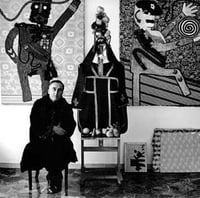
This analysis of Enrico Baj’s Fantasma (1960s) draws on the supplied facts: a Neo-Dada abstract work by a leading Italian artist. While specific visual details are limited, the significance of Fantasma emerges from its radical fusion of material play, dark humor, and social critique—hallmarks of Baj’s practice and of Neo-Dada as a whole.
Style and Context: Neo-Dada’s Anti-Aesthetic
As a Neo-Dada piece, Fantasma (Italian for “ghost”) rejects traditional painting’s preciousness. Baj, a co-founder of the Nuclear Art movement and later a key figure in European Neo-Dada, shared with American counterparts like Rauschenberg and Johns a fascination with “poor” materials and the absurd. But his work is explicitly politicized. Where earlier Dada mocked the establishment, Baj’s Neo-Dada targets postwar bourgeois conformity, militarism, and the empty spectacle of mass culture. Fantasma likely employs his signature technique: coarse burlap, patches, buttons, mirrored fragments, and cheap printed fabrics assembled into a grotesque, quasi-figurative abstraction. The title—a ghost—suggests a playful yet unsettling presence, something both spectral and corporeal.
Significance Within Neo-Dada and Abstraction
Fantasma is significant for several reasons:
-
Materiality as Meaning – Baj’s use of cast-off textiles and debris turns the abstract surface into a battlefield of textures. Unlike Abstract Expressionist paint, his materials carry social weight: army-surplus fabric, cheap lace, shabby upholstery. In Fantasma, these rags become the ghost’s “body,” a critique of post-war consumerism that renders people as disposable, patchwork figures. The work challenges the clean geometry of contemporary abstraction (e.g., Mondrian or Barnett Newman) by embracing the grotesque, the handmade, the ugly.
-
The Grotesque and the Absurd – Though categorized as abstract, Baj’s works often retain a ghostly anthropomorphism. Fantasma likely hovers between abstraction and figuration, a shambolic entity assembled from disparate parts. This aligns with Neo-Dada’s interest in the “thingness” of art—the object as a disquieting presence, not a window onto beauty. The ghost becomes a metaphor for the malaise beneath polite society; it is an anti-heroic, anti-rational apparition.
-
Transnational Neo-Dada – While American Neo-Dada often focused on the cool, ironic surface, Baj’s version is hotter, more manic, and overtly political. Fantasma embodies this European strain: a ghost that haunts the ruins of war and the vacuity of the “economic miracle.” Its abstraction is not purely formal but loaded with narrative and satire. Baj’s technique of pittura povera (poor painting) prefigures the Arte Povera movement of the late 1960s, making Fantasma a transitional work between Neo-Dada and Italian conceptual art.
Conclusion: Why It Matters
Fantasma matters because it demonstrates how Neo-Dada expanded the boundaries of abstraction. It is not a neutral surface but a critical object: an abstract ghost that laughs at the solemnity of modernism while conjuring the anxieties of its age. By rejecting hierarchy of materials and embracing the abject, Baj gives abstraction a new purpose—not as pure form, but as haunted, ironic testimony.
Görsel olarak benzer
İlişkili kompozisyon ve renk paletine sahip 20 eser
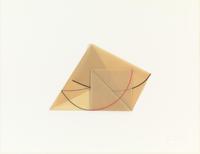
Triangle, Rectangle, Small Square
Dorothea Rockburne
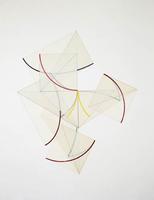
Arena V
Dorothea Rockburne
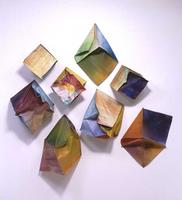
Cubes
Sam Gilliam

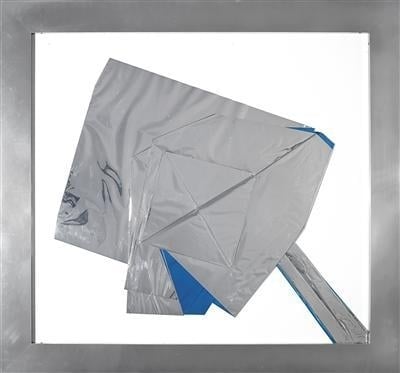
Double Kite
Charles Hinman
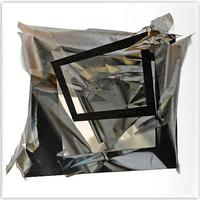
SMS 11
Larry Bell
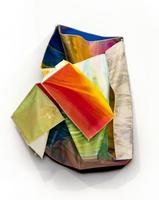
Sac 2
Sam Gilliam
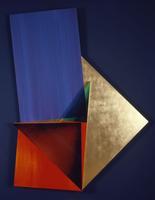
Pascal, State of Grace
Dorothea Rockburne
Untitled
Marcelle Cahn
Composition No. 116
Friedrich Vordemberge-Gildewart
Ravaged land
Paul Klee
Guardian Angel, II
Dorothea Rockburne

Vier uberlagerte zonen
Max Bill
Drawing Which Makes Itself
Dorothea Rockburne
La guitar rose
Henri Laurens
AAAAA113 Mirage Work
Larry Bell
Lost Space
Guy Mees
Enroute
Charles Hinman
Untitled No. 59
Claude Viallat
Espaces concertés
Francis Bott

Untitled
John Armleder