Analisi esperta di Bergwiese di Gabriele Munter
Stile: Expressionism · Genere: landscape
Expert Analysis of "Bergwiese" by Gabriele Munter
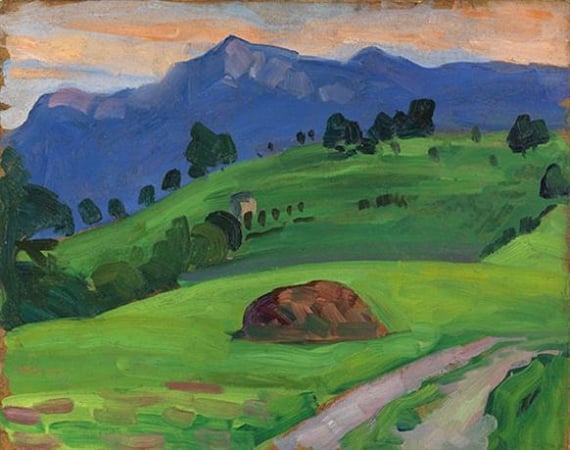
As an Expressionist landscape, "Bergwiese" (Mountain Meadow) exemplifies the movement's core goal: conveying emotional and psychological truth through bold, distorted forms and intense, non-naturalistic color. Munter’s work is significant within Expressionism for its direct, often forceful brushwork and a personal, lyrical vision of nature that bypasses mere description in favor of pure feeling.
Stylistic Significance:
- Expressionist Landscape Tradition: Unlike Impressionist landscapes that prioritize optical sensation, Munter’s meadow becomes a stage for inner experience. The work likely employs vivid, unmixed colors and simplified, almost symbolic shapes—hallmarks of German Expressionism—to evoke the raw vitality of the alpine scene.
- Visual Language: The title “Bergwiese” suggests a meeting of mountain and meadow, a subject Munter frequently explored in her travels. The composition probably emphasizes rhythmic patterns of hills, flowers, and sky, flattening space to heighten decorative and emotional impact—a technique she absorbed from her association with Der Blaue Reiter group (notably Vassily Kandinsky).
Artist’s Contribution: Gabriele Munter stands as a pioneering female figure in Expressionism. Her landscapes retain a sense of unmediated, almost naïve freshness that distinguishes them from the more theoretical or apocalyptic works of her male contemporaries. “Bergwiese” demonstrates her ability to transform a humble nature motif into a vibrant, subjective vision—a quality that makes her work essential to understanding how Expressionism democratized emotional expression in painting.
Period Context: At a time when landscape was often used to flee modernity, Munter’s Expressionist interpretation insists on the artist’s inner world as the true subject. The work’s significance lies in its defiant embrace of simplicity and color as vehicles for profound spiritual content—a defining characteristic of the movement’s mature phase (c. 1910–1914).
Visivamente simili
20 opere con composizione e palette affini
HAYFIELD IN SUMMER
Marjorie Acker Phillips
Ricks
Istvan Nagy
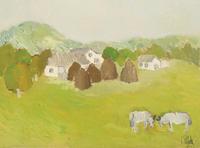
At the Aunts
Constantin Piliuta
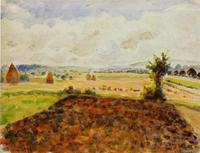
Landscape at Eragny, Clear Weather
Camille Pissarro
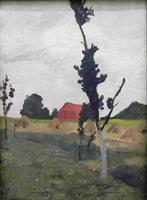
Worpsweder Landscape with Red House
Paula Modersohn-Becker
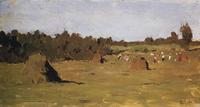
Haymaking
Isaac Levitan
Stacks of Wheat (End of Day, Autumn)
Claude Monet
Study
Hugo Mühlig
Landscape with Haystacks
Samuel Peploe
Stacks of Wheat (End of Summer)
Claude Monet
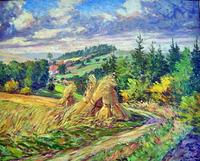
SUMMER LANDSCAPE
JAROSLAV KELUC
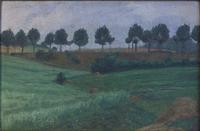
Landscape
Hans Andersen Brendekilde
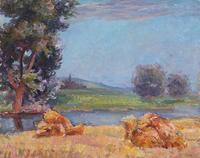
Vară
Samuel Mutzner
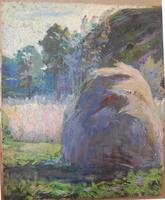
Haystack
Hélène Guinepied
Fields. Neskuchnoye
Zinaida Serebriakova
In Plyos
Isaac Levitan
Harvest
Zinaida Serebriakova
Corn Stacks, Pownal , VT
Frank Mason
Modok Mária, Nagybányai Széna Bogja 1926
Modok Mária
Summer Landscape
Stefan Popescu