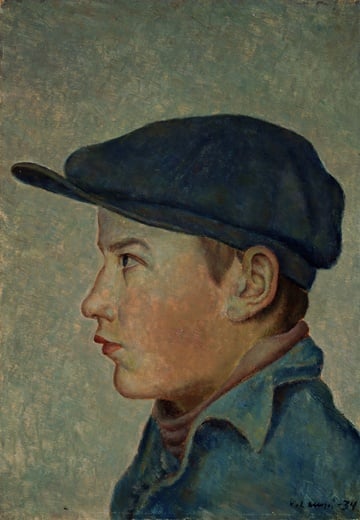
Analisi esperta di Pojan kuva (Eeli Kaitera) di Vilho Lampi
Stile: Expressionism · Genere: portrait
Analysis of "Pojan kuva (Eeli Kaitera)" by Vilho Lampi
As an expressionist portrait, this work exemplifies the core aims of early 20th-century Expressionism: to convey emotional experience and subjective perception rather than objective reality. The title—Pojan kuva (Eeli Kaitera)—identifies the sitter, grounding the piece in a specific individual, yet the stylistic treatment lifts it beyond mere likeness.
Significance within Expressionism
In Expressionist portraiture, the artist distorts form, color, and line to evoke the inner psychological state of the subject (and often the artist’s own response). Lampi’s approach likely emphasizes bold brushwork, intensified hues, and simplified or exaggerated features—all hallmarks of the movement. The portrait’s significance lies in its rejection of naturalistic representation in favor of capturing the essence or mood of the boy, Eeli Kaitera. By stripping away extraneous detail and focusing on emotional intensity, Lampi aligns his work with Expressionists such as Edvard Munch or the German Die Brücke painters, who saw the portrait as a vehicle for universal human feeling.
Genre Innovation
Within the portrait genre, this painting pushes boundaries by prioritizing expression over documentation. Traditional portraiture seeks to immortalize a sitter’s status or likeness; Lampi’s version instead transforms the face into a field of psychic energy. The choice of a boy as subject also introduces themes of youth, vulnerability, or raw emotion, which Expressionists often explored to access primal human experiences.
Artistic Context
While no additional biographical or contextual facts are provided, the work’s classification as Expressionist marks its departure from Finnish naturalistic or romantic traditions of the early 1900s. Lampi’s decision to employ such a style for a portrait of a young boy demonstrates a commitment to personal vision over academic convention, making Pojan kuva (Eeli Kaitera) a striking example of how Expressionism reshaped the portrait genre into a mirror of inner life.
Visivamente simili
20 opere con composizione e palette affini
Self-portrait Wearing Cap
Lajos Tihanyi
Egich Chubar Portrait
Panos Terlemezian
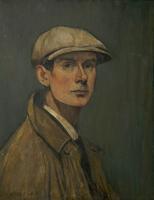
Self Portrait
L. S. Lowry
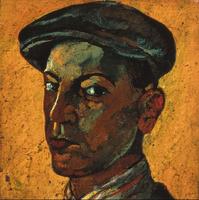
Vajda Lajos Önarckép 1924 Olaj, Papír 370x360
Vajda Lajos
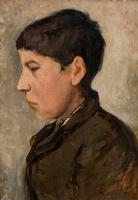
Head of a boy
Silvestro Lega
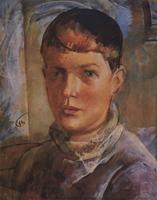
The daughter of an artist
Kuzma Petrov-Vodkin
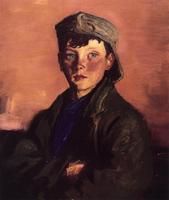
Charles O'Malley
Robert Henri
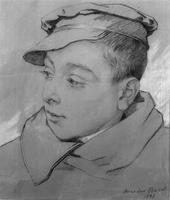
The artist's brother Antioco as a child
Amedeo Bocchi
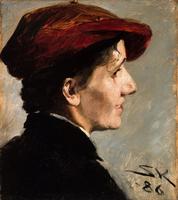
P.S. Krøyer
Marianne Stokes
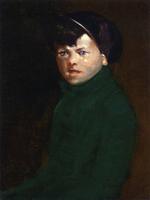
Flyweight Champion of Jumel Place
George Luks
Head of a boy, Venice
Eugene de Blaas
Portrait of a Boy
Jan Mankes
Portrait of a Boy
Jan Mankes
Bucko O'Malley (Charles)
Robert Henri
Head of young beggar
Joan Brull
Boy's Head
Sergiy Grigoriev
Self-Portrait
Robert Brackman
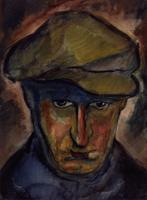
Self-Portrait
Vilho Lampi
Copil cu beretă verde
Octav Angheluta
Head of a Peasant Woman with Dark Cap
Vincent van Gogh