The Great Masturbator
Details
Description
Stijl: Surrealism · Genre: symbolic painting
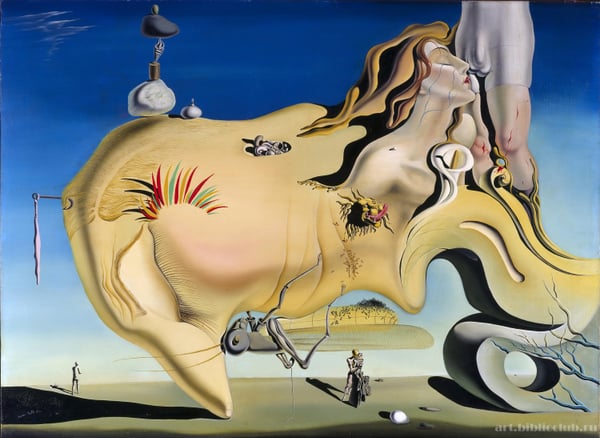
The Great Masturbator (1929) is an autobiographical painting, in which the artist addresses his anxieties, fears, and sexual obsessions. At the center of the painting is a large amorphous form that is a distorted self-portrait of the artist: Dalí depicts himself with his eyes shut and a large grasshopper placed on his mouth. Similar versions of the self-portrait appear in Dalí’s other paintings including the famous masterpiece The Persistence of Memory (1931). According to Dalí, he based the self-portrait on a rock formation in Cap de Creus, located along the shore of his homeland, Catalonia. Some scholars have also drawn a parallel between the self-portrait and a section of Hieronymus Bosch's The Garden of Earthly Delights (1510-1515) – on the right side of the left panel Bosch depicts rocks, bushes, and small animals that resemble the profile with the prominent nose and long eyelashes.
The artist casts himself as “the great masturbator”, and his hidden desire manifests itself through the female figure that emerges from the nape of his neck. She is identified as Gala Éluard, Dalí’s muse, and future wife. Her head and mouth are next to the crotch of a standing male figure, that is only visible from the waist down and cut off at the knees. Dalí painted The Great Masturbator in the later summer of 1929, at the early stages of his relationship with Gala, who at the time was still married to his friend and colleague, the Surrealist poet Paul Éluard. The painting expressed the artist’s anxieties about their relationship, both regarding the circumstances of their romance and his fear of being taken advantage of or swallowed up by Gala. Gala’s presence is ambiguous, she is both loved and feared. She represents the artist’s fear of castration and female sexuality, but also the potential to achieve spiritual and sexual liberation through this relationship.
The most threatening element of the painting is the grasshopper, which relates to Dalí’s childhood fear of insects. Dalí often wrote poems that accompanied his paintings, and in the poem for The Great Masturbator, he referred to the insect as a locust. For Dalí, the fear of the grasshopper or the locust related to the idea of being swallowed up or consumed, which is likely why the grasshopper clings to the lower part of the face, in place of the mouth. According to one interpretation, the grasshopper serves as another representation of Gala. This claim is supported by another painting from the period, Portrait of Paul Éluard (1929). He began the portrait while Gala was still with Éluard, but by the time he finished, she had left Éluard. The portrait shares several elements with The Great Masturbator: the roaring lion, the profile portrait of Dalí, and most importantly the grasshopper. The grasshopper likely implies Gala’s presence, and in a similar way, it signifies Dalí’s anxieties regarding adultery and the implications of their relationship.
The Great Masturbator remained in the artist’s personal collection. After his death, the painting was willed to the national collection of Spain, and today it is part of the Museo Reina Sofía collection in Madrid.
Genre
Stijl
Visueel vergelijkbaar
20 werken met verwante compositie en kleurenpalet
Cadavre Exquis (Surrealist Group Collective Work)
Marcelino Vespeira
Surrealist Architecture
Salvador Dali
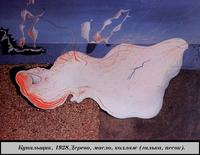
The Bather
Salvador Dali
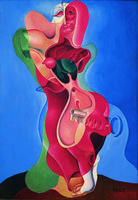
THE WOMAN WITH A KEY
Yervand Kochar
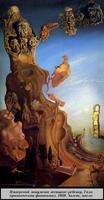
Imperial Monument of Woma-Child. Gala (Utopian Fantasy)
Salvador Dali
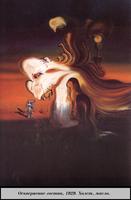
Desecration Descripti
Salvador Dali
Profanation of the Host
Salvador Dali
Apparition of Face and Fruit Dish on a Beach
Salvador Dali
Autumnal Cannibalism
Salvador Dali
Female Bather
Salvador Dali
Little Cinders (Senicitas)
Salvador Dali
Composition
Salvador Dali
Invisible Sleeping Woman, Horse, Lion
Salvador Dali
Dolor de mediodía
Angel Planells
Landscape with Wheatgerm
Max Ernst
Lovers' White Dreamtime
Desmond Morris
Gynandrologie
Jaroslav Serpan
Atavistic Vestiges After the Rain
Salvador Dali
The Three Glorious Enigmas of Gala
Salvador Dali
St Ishmael's
Graham Sutherland