
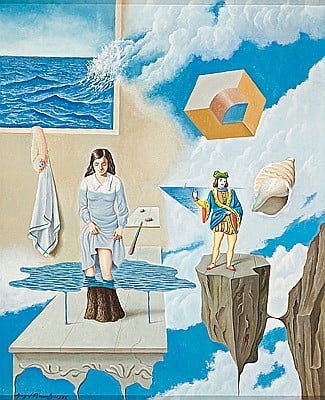
Analisi esperta di Pintura surrealista di Angel Planells
Stile: Surrealism · Genere: symbolic painting
Expert Analysis: "Pintura surrealista" by Angel Planells
Angel Planells (1901–1989) was a Catalan painter closely associated with the first generation of Spanish Surrealists, often linked to his fellow countryman Salvador Dalí. Although the provided facts are limited to the title, style, and genre, the work’s significance can be understood through its dual identity as both a Surrealist piece and a symbolic painting.
Surrealist Context and Symbolic Language
As a Surrealist work, "Pintura surrealista" (which translates simply to "Surrealist Painting") likely employs the movement’s hallmark techniques: dreamlike juxtaposition, irrational composition, and the exploration of the subconscious. However, the specification of symbolic painting as its genre suggests that Planells intentionally embedded a layer of allegorical meaning—perhaps drawing on personal, mythological, or cultural symbols. This was characteristic of Planells’ mature style, where he moved away from Dalí’s more provocative iconography toward a quieter, more poetic symbolism, often evoking Mediterranean landscapes, nautical motifs, and melancholic figures.
Significance within Surrealism
Planells’ work is significant because it represents a less flamboyant, more introspective branch of Surrealism. While Dalí sought to shock and disturb, Planells used Surrealist visual language to explore themes of memory, time, and longing. In "Pintura surrealista", the symbolic elements—whether a suspended clock, a desolate shore, or a mysterious object—are not merely random but are carefully chosen to evoke a specific emotional or metaphysical state. This aligns with the Surrealist goal of accessing deeper truths, but Planells’ approach is notable for its restraint and lyrical quality.
Symbolic Painting as a Bridge
By categorizing the work as symbolic painting, Planells bridges Surrealism with older traditions of emblematic and allegorical art (e.g., Renaissance or Symbolist painting). This is significant because it demonstrates how Surrealism could be integrated with classical symbolic systems, lending the movement historical depth. The title itself—generic and unadorned—forces the viewer to focus solely on the painted symbols without the distraction of a narrative clue, making the artwork an exercise in pure symbolic interpretation.
In summary, "Pintura surrealista" is significant as a refined example of Planells’ personal Surrealism, where symbolic clarity and emotional resonance replace the more chaotic automatism of other surrealists. It stands as a testament to the diversity within the Surrealist movement and the enduring power of symbolic imagery to convey subconscious states.
Visivamente simili
20 opere con composizione e palette affini
Enigma i calma sobre el mar
Angel Planells
La casa fantasmal
Angel Planells
El mar desconegut
Angel Planells
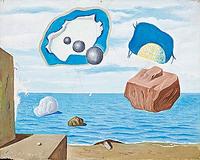
El fantasma rosa
Angel Planells
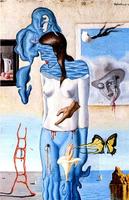
Dona i cap d’home
Angel Planells
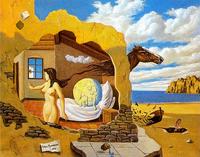
The Moon Does Not Want Visits
Angel Planells
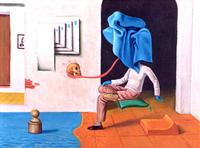
Hamlet
Angel Planells
Mural Painting for Helena Rubinstein (panel 2)
Salvador Dali
Caminen plegats el desasre i el somni
Angel Planells
Figures Lying on the Sand
Salvador Dali
A World
Ángeles Santos Torroella
Wedding Travelling in Space
Sabin Balasa
Creation of the world or microcosm
Remedios Varo
Terasa blage vesti
Leonid Šejka
Curtsey
Dmytro Kavsan
Bortnyik Sandor
Sandor Bortnyik
Study for the Backdrop of 'Mad Tristan' (Act II)
Salvador Dali

Dreams on a Beach
Salvador Dali
The Army. The War Series
Joan Tuset
Galatée
Salvador Dali