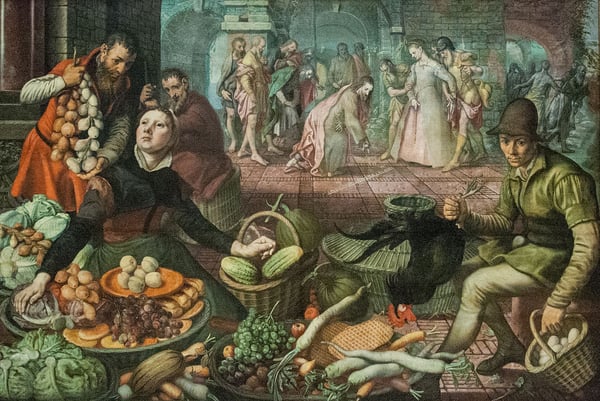
Christ and the Woman Taken in Adultery
Dettagli
Analisi esperta di Christ and the Woman Taken in Adultery di Pieter Aertsen
Stile: Northern Renaissance · Genere: religious painting
Pieter Aertsen’s Christ and the Woman Taken in Adultery is a telling example of the Northern Renaissance’s shift toward intertwining sacred narratives with the textures of everyday life. Aertsen, a Dutch master, is celebrated for pioneering the “inverted still life”—placing a detailed, secular foreground while relegating the biblical subject to a distant background. This composition exemplifies that innovation.
Significance within the Northern Renaissance:
-
Juxtaposition of Sacred and Profane: The painting’s primary focus is a lavish market or kitchen scene, overflowing with foodstuffs, utensils, and figures engaged in mundane activities. Only in the background—often through a doorway or window—does the titular story of Christ and the adulterous woman unfold. This deliberate hierarchy reflects the Northern Renaissance fascination with the material world and the belief that divine truth could be glimpsed through the ordinary. Aertsen uses this contrast to invite moral reflection: the abundance of earthly goods serves as a foil to the spiritual lesson of forgiveness.
-
Pioneering Genre and Still Life: Aertsen’s work is a crucial bridge between late medieval religious art and the independent genre scenes of the Dutch Golden Age. By devoting the vast majority of the canvas to produce, meat, and kitchenware, he elevates still-life elements to a prominence rarely seen before. His meticulous rendering of textures—coarse breads, gleaming fish, polished copper vessels—demonstrates the Northern Renaissance’s commitment to naturalistic detail and optical precision.
-
Moral and Didactic Undertones: The contrast between foreground abundance and background redemption is not merely formal but thematic. The woman taken in adultery, saved by Christ’s mercy, stands as a counterpoint to the worldly indulgence surrounding her. Aertsen thus engages the viewer in a visual sermon: the pleasures of the senses are transient, while divine grace offers eternal deliverance. This moral complexity, embedded in a seemingly ordinary scene, is a hallmark of the Northern Renaissance’s approach to religious art.
-
Influence on Later Art: Aertsen’s method of embedding a small religious climax within a vast genre composition directly influenced his nephew Joachim Beuckelaer and, later, 17th-century Dutch painters such as Pieter Claesz and Willem Kalf. His work demonstrates that even a traditional biblical subject could be reimagined through the lens of Northern realism, making the sacred accessible within the familiar.
In sum, Christ and the Woman Taken in Adultery is a masterwork of the Northern Renaissance precisely because it challenges the viewer to look beyond the surface—a visual and spiritual exercise that encapsulates the era’s devotion to both the seen and the unseen.
Museum / Gallery
Visivamente simili
20 opere con composizione e palette affini
Market with Christ and the Woman Taken in Adultery
Pieter Aertsen
Christ and the Adulteress
Pieter Aertsen
Wedding Feast at Cana
Jan Steen
Kitchen Scene
Joachim Wtewael
Drunk woman
Jan Steen
The Cat Family
Jan Steen
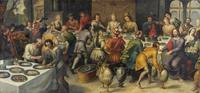
The Wedding at Cana
Adam van Noort
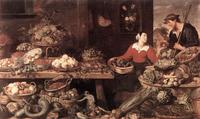
Fruit and Vegetable Market
Frans Snyders
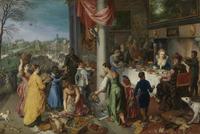
Der Winter
Jan Brueghel the Elder
German Artists Make Their Sketches in Rome
Wilhelm von Kaulbach
Children playing in a street outside a cobbler's shop
Matthijs Naiveu
Samson and Delilah
Jan Steen
A Roman street letter-writer writing a letter for a young girl
Ernst Meyer
Scena Dell'ostello
Pieter Brueghel the Younger
The Witches' Kitchen
Frans Francken the Younger
Parable of the Prodigal Son
Jan van Hemessen
Quack and His Assistant
Jan Miense Molenaer
A Fruit Stall
Frans Snyders
Cheated groom
Jan Steen
Return of the prodigal son
Jan Steen