
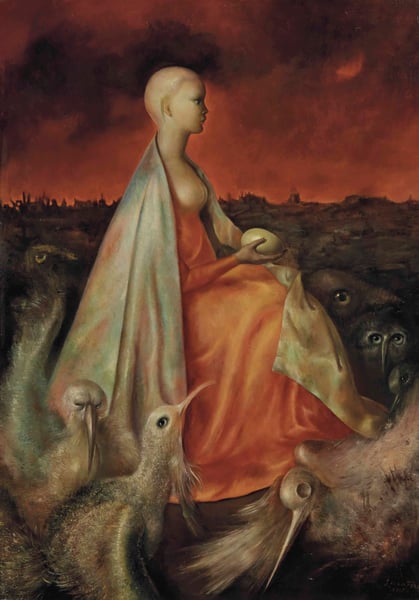
Expertenanalyse zu Leonor Finis La Gardienne des Phénix
Stil: Magic Realism, Surrealism · Genre: symbolic painting
Expert Analysis: "La Gardienne des Phénix" (The Guardian of the Phoenixes) by Leonor Fini
Leonor Fini’s La Gardienne des Phénix stands as a vital, often underappreciated contribution to both Surrealism and Magic Realism. Painted within the symbolic genre, the work exemplifies Fini’s unique position as a female artist who resisted the orthodoxies of the male-dominated Surrealist movement while simultaneously embracing its core interest in the unconscious, metamorphosis, and the mythic feminine.
Significance within Surrealism:
Unlike the more passive, objectified female figures frequently depicted by male Surrealists (e.g., in works by Magritte or Dalí), Fini’s guardian is an active, autonomous presence. The phoenix—a symbol of cyclical rebirth, fire, and resilience—is traditionally associated with transformation. By placing a female figure as its guardian, Fini reclaims agency: she is not a muse or an eroticized spectacle, but a custodian of esoteric power and regeneration. This aligns with Surrealism’s revolutionary aims—to disrupt rational order—but does so through a distinctly feminist lens, foregrounding women as myth-makers and gatekeepers of the psyche.
Magic Realism and Symbolic Genre:
Magic Realism’s hallmark is the seamless fusion of everyday reality with the extraordinary, rendered with precise, matter-of-fact detail. In La Gardienne des Phénix, this manifests in the tension between the plausible—perhaps a woman in a fantastical landscape—and the impossible presence of mythical birds. The phoenixes themselves would likely be depicted with hyper-realistic feathers and anatomy, yet their existence is unmoored from natural law. This juxtaposition creates a dreamlike but not irrational atmosphere, typical of Magic Realism, where the symbolic meaning (rebirth, guardianship, transcendence) is embedded in a visually convincing world.
Symbolic Content:
The phoenix, rising from ashes, also references Fini’s own artistic trajectory. As a woman working in a male-centric avant-garde, she continually reinvented herself—stylistically and thematically. The guardian figure can be read as a self-portrait of the artist as keeper of her own creative flame, protective of the transformative cycles that define both art and the feminine. The painting thus becomes a meditation on creation, destruction, and renewal—central to the symbolic genre, which prioritizes allegorical meaning over literal narrative.
Conclusion:
La Gardienne des Phénix is significant precisely because it subverts Surrealist clichés through a Magic Realist lens. It elevates the female figure from object to architect of myth, merging the precise observation of Magic Realism with the psychic depth of Surrealism. In doing so, it offers a potent emblem of artistic and personal autonomy, making Fini a crucial, transformative voice within these movements.
Visuell ähnlich
20 Werke mit ähnlicher Komposition und Farbpalette
La Guardiana del Huevo negro
Leonor Fini
The Giantess
Leonora Carrington
Woman on a Terrace (Young Woman and Ibis)
Edgar Degas

Portrait of the Late Ms Partridge
Leonora Carrington
Mother and Child
Francis Day
Tristeza Andaluza
Julio Romero de Torres
Salomé
Jean Benner
Serenata Açoriana
Antonio Dacosta
Untitled
Montserrat Gudiol
Magdalena
Julio Romero de Torres
Leda and the Swan
Palma il Giovane

Twins By The Sea
Odd Nerdrum
The Venus That was Never Finished
John Duncan
Big Hello to a Forest Nymph of Lucas Cranach
Alexander Roitburd
Joan of Arc
Odilon Redon

María Teresa Llavallol, Mrs. Atucha
Ignacio Zuloaga
Untitled
Antonio Bueno
Christ in the Wilderness - The Eagles
Stanley Spencer
Princess Maria Volkonsky at the age of twelve
Balthus
The Unicorn in the Forest
Stefan Caltia