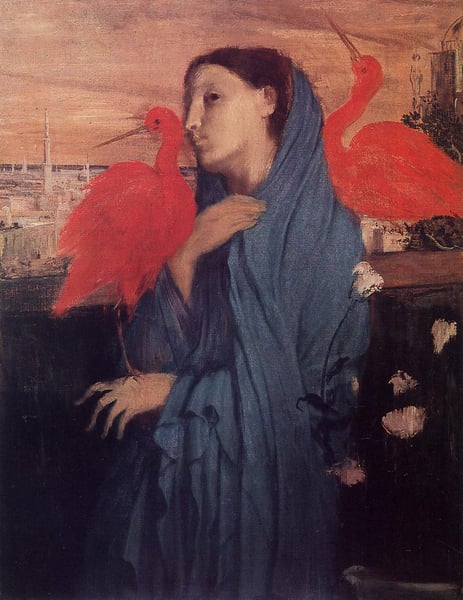
Expert Analysis of "Woman on a Terrace (Young Woman and Ibis)" by Edgar Degas
As an Impressionist genre painting, Degas’s Woman on a Terrace (Young Woman and Ibis) exemplifies the movement’s fascination with capturing fleeting, intimate moments of modern life—here, a quiet, slightly exotic encounter between a young woman and an ibis. While many Impressionists prioritized open-air landscapes and shimmering light, Degas distinguished himself through his rigorous draftsmanship and unconventional compositions. This work is significant because it reflects his signature blend of precise linework and spontaneous pose, a hallmark of his contribution to the style. The inclusion of the ibis—a bird not native to Paris—hints at a taste for the cosmopolitan and the everyday surreal, typical of Degas’s choice of subjects that defy easy narrative. The terrace setting suggests a boundary between private and public space, allowing the artist to explore the psychology of the sitter and the fleeting nature of a gesture. Within the broader Impressionist period, this painting stands as a testament to Degas’s unique ability to merge classical structure with modern, off-kilter observation, elevating a simple genre scene into a study of human and animal interaction that feels both poised and transient.