Analisi esperta di Komposition Verwa di Carl Buchheister
Stile: Art Informel · Genere: abstract
Expert Analysis of "Komposition Verwa" by Carl Buchheister
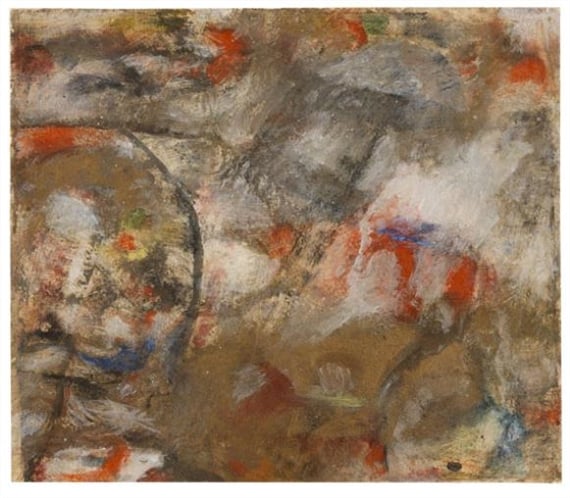
Carl Buchheister’s Komposition Verwa stands as a compelling exemplar of Art Informel, the European post-war movement that championed spontaneity, materiality, and the liberation of form from geometric or representational constraints. While the supplied facts are minimal—identifying the work as abstract within this style—its significance can be understood through Buchheister’s unique trajectory and the broader aesthetic of informe.
Context & Artistic Evolution
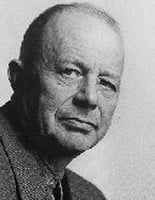
Buchheister began his career as a Bauhaus student under Kandinsky and Klee, initially producing rigorous, constructivist abstractions. By the 1950s, however, he had shifted toward Art Informel, a reaction against both the rationalism of pre-war abstraction and the existential trauma of World War II. Komposition Verwa (likely from this period) reflects his deliberate abandonment of strict geometry in favor of organic, gestural marks and material experimentation.
Visual & Conceptual Significance
In Komposition Verwa, Buchheister employs the core principles of Art Informel:
- Spontaneity over planning: The composition likely features dynamic, sweeping brushstrokes or blotches of paint that seem to arise from an improvised, almost automatic process. This emphasizes the artist’s physical gesture as an immediate expression of inner energy.
- Materiality and texture: True to the movement, Buchheister often mixed sand, plaster, or other substances into his paint, creating rough, tactile surfaces that invite touch. The verwa in the title may hint at a sense of “displacement” or “alienation” (perhaps referencing the German ver-wahrt or ver-wirrt), aligning with Informel’s existential undertones.
- Rejection of composition as hierarchy: Unlike Kandinsky’s carefully balanced compositions, Buchheister here deliberately disrupts traditional focal points. Forms bleed into one another, with no clear center—a visual metaphor for the fragmented, uncertain human condition of the post-war era.
Comparison to Peers
Where contemporaries like Wols or Jean Fautrier emphasized agitated, visceral marks, Buchheister retained a subtle, lyrical restraint derived from his Bauhaus roots. Komposition Verwa likely occupies a middle ground: its abstract forms are neither entirely chaotic nor fully controlled, suggesting a dialogue between structure and its dissolution. This tension makes the work significant—it bridges the rational abstraction of the 1920s with the raw emotionalism of Informel, demonstrating that even within a movement defined by chance, traces of prior discipline can enrich the outcome.
Why It Matters
Komposition Verwa is significant not merely as an example of Art Informel, but as a document of Buchheister’s personal evolution. It embodies the movement’s core ambition: to let the painting “happen” as a record of the artist’s encounter with materials and the unconscious. In doing so, it challenges viewers to abandon the search for fixed meaning and instead experience the work as a field of pure visual energy—a hallmark of postwar abstraction’s turn toward process over product.
Visivamente simili
20 opere con composizione e palette affini
L'uccello Di Fuoco
Afro
Composition
Afro
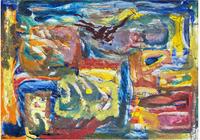
Composition
Valerii Lamakh
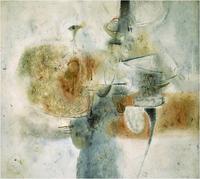
A mediodía
Lilia Carrillo
Paragraphe pour un mois de mars
Jean Messagier
An Italian Landscape with Trees
Ralph Rosenborg
Pallas Athena--Earth
Grace Hartigan
Untitled #6
Milton Resnick
Sera Romana
Giuseppe Santomaso
Secret Life (Vita Segreta)
Giuseppe Santomaso
Eclats
Jean Le Moal
Abstract
Sonya Rapoport
Libusa
Emil Schumacher
Clock
Philip Guston
Luna de silencio
Lilia Carrillo
Procreation
Nemanja Vučković
Woman
Willem de Kooning
Soir à Veere
Jean Rene Bazaine
Luerne
Stig Brøgger
La clessidra
Afro