
Expertenanalyse zu Benvenuto Tisis Presentation at the Temple
Stil: Mannerism (Late Renaissance) · Genre: religious painting
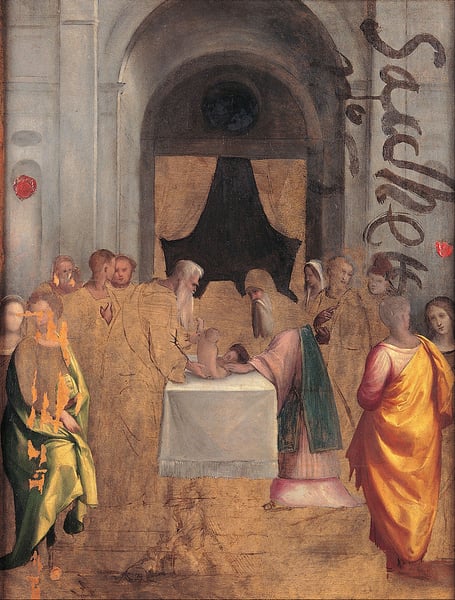
Expert Analysis: "Presentation at the Temple" by Benvenuto Tisi (Il Garofalo)
Benvenuto Tisi, better known as Il Garofalo, was a leading Ferrarese painter of the Late Renaissance, and his Presentation at the Temple is a compelling example of Mannerist religious painting. The work’s significance lies in how it exemplifies the core Mannerist departure from the harmonious naturalism of the High Renaissance, instead embracing artificiality, spatial complexity, and heightened emotional tension.
Mannerist Characteristics in the Composition
In typical Mannerist fashion, Garofalo manipulates the sacred scene—Christ’s presentation in the Temple—to create a sense of refined unease. The figures are likely elongated and posed in elegant, serpentine (figura serpentinata) stances, drawing attention to their graceful but unnatural postures. The composition eschews the balanced, pyramidal order of Raphael’s generation; instead, it may crowd the space with overlapping bodies and ambiguous spatial relationships, forcing the viewer’s eye to move restlessly across the canvas. The use of vivid, often acidic or cool colors—a hallmark of Ferrarese Mannerism—heightens the theatricality, while the architecture of the Temple itself might be rendered in a fantastical, non-classical manner, further flattening depth and emphasizing surface pattern.
Significance within Mannerism
Garofalo’s work is significant because it bridges the early Mannerism of Andrea del Sarto and the more extreme, intellectual strain later seen in Pontormo or Parmigianino. Presentation at the Temple retains a religious solemnity but subverts it with artifice: the gestures of the figures (Simeon, the Virgin, the prophetess Anna) are likely more rhetorical than natural, their emotions conveyed through contrived poses rather than direct expression. This reflects the Mannerist preoccupation with grazia (grace) and ingegno (inventive skill) over mere imitation of nature.
Place in Garofalo’s Oeuvre
For Garofalo, this painting also demonstrates his synthesis of two major influences: the classicizing harmony he absorbed from Raphael (whose work he studied in Rome) and the more idiosyncratic, decorative tendencies of his Ferrarese training under Panetti and Costa. The resulting work is neither purely devotional nor purely decorative; it is a learned, self-aware performance of artistry—exactly what defined Mannerist religious painting in the later 16th century.
In sum, Presentation at the Temple is significant as a refined, stylized interpretation of a standard biblical subject, one that prioritizes aesthetic complexity and emotional ambiguity over naturalistic clarity, marking it as a key document of Mannerist religious art.
Visuell ähnlich
20 Werke mit ähnlicher Komposition und Farbpalette
The Presentation of Christ in the Temple
Lorenzo Lotto
Death of the Virgin
Andrea Mantegna
The vision of St. Bernard
Pietro Perugino

Presentation of Christ
Bernard Van Orley
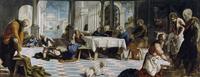
Christ Washing the Feet of His Disciples
Tintoretto
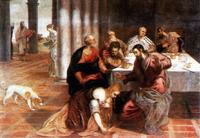
Christ in the house of the Pharisee
Tintoretto
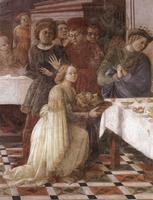
The Feast of Herod: Salome's Dance (detail)
Filippo Lippi
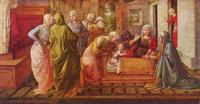
Ambrose Legend
Filippo Lippi
Christ Among the Doctors
Jacopo Bassano
The Presentation in the Temple
Raphael
The Communion of the Apostles (Eucharist Altarpiece)
Justus van Gent
Presentation in the Temple
Vittore Carpaccio
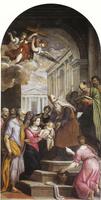
Presentation of Jesus Christ at the Temple
Palma il Giovane
Last Supper
Paolo Veronese
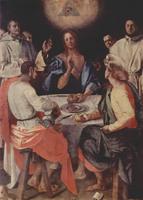
Last Supper at Emmaus
Jacopo Pontormo
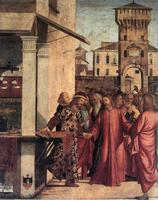
The Calling of St. Matthew
Vittore Carpaccio
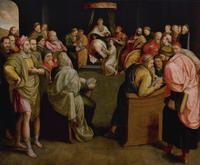
Christ among the Doctors
Frans Pourbus the Elder
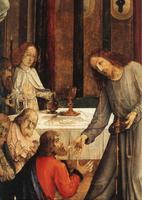
Eucharist Altarpiece (detail)
Justus van Gent
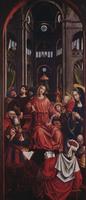
Christ's dispute at the Temple
Defendente Ferrari
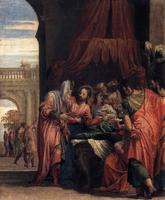
Raising of the Daughter of Jairus
Paolo Veronese