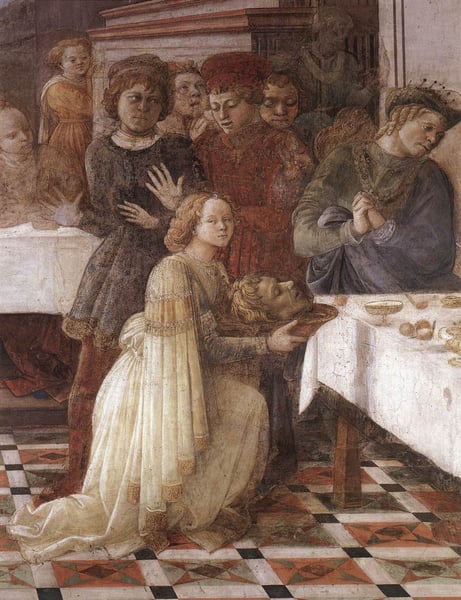
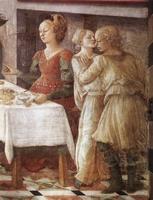
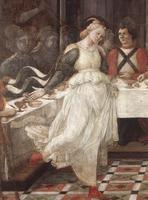
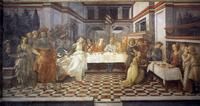
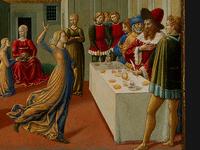
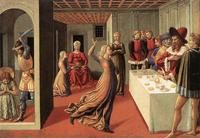
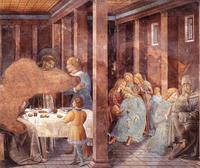
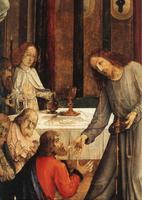
Given the supplied facts—Filippo Lippi’s The Feast of Herod: Salome’s Dance (detail), an Early Renaissance religious painting—its significance lies in the way Lippi bridges the devotional narrative with the emerging humanist concerns of his time. The detail format itself highlights a key shift: instead of a static, iconic holy scene, Lippi isolates the secular, dramatic moment of Salome’s dance, infusing it with naturalistic gesture, anatomical grace, and a sense of spatial depth typical of the Early Renaissance. This focus on expressive human action, even within a biblical story, marks a departure from the more rigid, symbolic compositions of the preceding Gothic style, underscoring the period’s interest in capturing psychological immediacy and physical realism. Lippi’s delicate handling of line and luminous color also reinforces the genre’s purpose—to make the sacred accessible and emotionally resonant for contemporary viewers.