Analisi esperta di View of Fuenterrabía di Luis Paret y Alcazar
Stile: Rococo · Genere: landscape
Expert Analysis: "View of Fuenterrabía" by Luis Paret y Alcazar
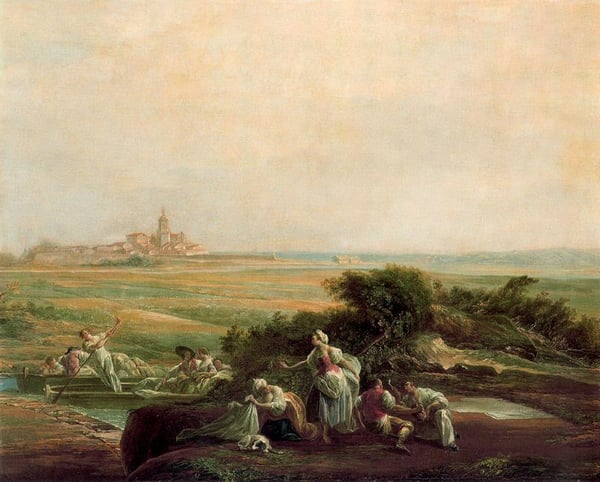
Luis Paret y Alcazar’s View of Fuenterrabía stands as a masterful synthesis of Rococo elegance and precise topographical observation, marking a significant contribution to Spanish landscape painting within the 18th-century Rococo tradition. While Rococo landscapes often favored pastoral idylls and mythological themes, Paret distinguished himself by applying the style’s hallmark delicacy, luminous color, and refined brushwork to a specific, recognizable locale—the fortified Basque town of Fuenterrabía (modern-day Hondarribia).
Significance Within the Rococo Style:
- Luminosity and Atmosphere: Paret captures a soft, golden light that bathes the town and its surroundings, creating a serene, almost theatrical atmosphere typical of Rococo’s preference for pleasurable, airy scenes. The gentle transitions of tone and the shimmering reflections on the water reveal his debt to French Rococo painters like Watteau, yet they are anchored in a real landscape rather than an arcadian fantasy.
- Graceful Composition: The painting balances architectural precision with natural elements. The town’s walls, church tower, and houses are rendered with delicate, detailed strokes, while the foreground’s flowing shoreline and scattered figures (likely fishermen or townsfolk) echo the Rococo love for asymmetrical, flowing arrangements. This composition invites the viewer’s eye to wander leisurely—a key ambition of Rococo art that sought to delight rather than instruct.
- Color Palette: Paret employs a restrained yet vivid palette of pale blues, warm ochres, and soft greens, avoiding the overly saturated tones of earlier Baroque landscapes. The harmony of these hues is quintessentially Rococo, emphasizing charm and visual pleasure over dramatic contrast.
Historical and Artistic Significance:
- Spanish Rococo with a Local Lens: Paret was one of the few Spanish painters to fully embrace the Rococo style, which had flourished mainly in France and Central Europe. View of Fuenterrabía exemplifies how he adapted this courtly aesthetic to Spanish subjects, injecting a sense of local identity and topographic veracity that foreshadows later Romantic and realist landscape traditions.
- Documentary Value: The painting is not merely decorative; it serves as an important visual record of 18th-century Basque coastal life and architecture. Paret’s careful depiction of the town’s fortifications, church, and harbor reflects the Enlightenment interest in cataloging and celebrating regional geography—a theme that elevates the work beyond pure Rococo ornament.
- Technical Refinement: Paret’s skill in rendering atmosphere—especially the subtle gradation of light across the sky and water—demonstrates his mastery of plein-air observation. This attention to naturalistic detail, combined with Rococo’s characteristic lightness, makes View of Fuenterrabía a standout example of how the style could accommodate both European sophistication and local specificity.
Conclusion: In View of Fuenterrabía, Luis Paret y Alcazar achieves a rare balance: a Rococo landscape that is both delightfully decorative and authentically documentary. Its significance lies in its ability to transport the viewer into a sunlit moment of 18th-century Spain, while simultaneously showcasing how the Rococo idiom—often dismissed as frivolous—could be harnessed for nuanced, place-specific representation. This work remains a key piece in understanding the breadth of Rococo landscape painting beyond the French court.
Visivamente simili
20 opere con composizione e palette affini
The Gravel Diggers
George Morland
Village Scene
Luis Paret y Alcazar
Morning, the Dance of the Nymphs
Camille Corot
An extensive landscape near Paris
Hubert Robert
The summer
Luca Carlevaris
Roman Ideal Landscape with Cephalus, Procris, and Diana
Claude Lorrain
Flight into Egypt
Jan Asselijn
The Kermesse
Peter Paul Rubens
Paesaggio bucolico con pastori
Alessandro Magnasco
Landscape with the Adoration of the Golden Calf
Claude Lorrain
Pastoral Landscape
Claude Lorrain
Landscape with Water Mill
Claude Lorrain
Landscape with a Gypsy Family
George Morland
The End Of The Day
William Shayer
Louis Xiv Devant Dole En 1668
Adam van der Meulen
A Gypsy Encampment
George Morland
Prédication De Saint Jean-Baptiste
Nicolas Antoine Taunay
Beach in Normandy
Richard Parkes Bonington
Landscape with Flight into Egypt
Claude Lorrain
Landscape with Paris and Oenone
Claude Lorrain