
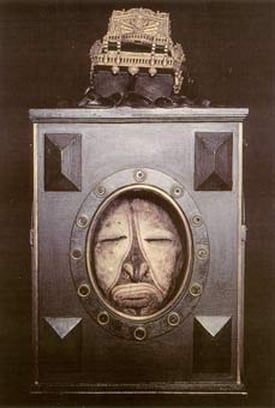
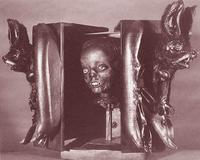
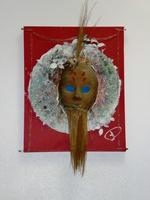
Reliquaire pour un crâne surmodelé du Moyen-Sepik, Nouvelle-Guinée
Dettagli
Analisi esperta di Reliquaire pour un crâne surmodelé du Moyen-Sepik, Nouvelle-Guinée di Mimi Parent
Stile: Surrealism · Genere: symbolic painting
Expert Analysis: "Reliquaire pour un crâne surmodelé du Moyen-Sepik, Nouvelle-Guinée" (Reliquary for a Modeled Skull from the Middle Sepik, New Guinea) by Mimi Parent
Within the Surrealist movement, Mimi Parent occupies a distinctive place as one of its most dedicated female members, and this work powerfully embodies the Surrealist fascination with the "primitive," the unconscious, and the ritualistic transformation of objects. As a symbolic painting, it functions not merely as a depiction but as a conceptual fusion of Western Surrealist automatism and Oceanic spiritual materiality.
Significance within Surrealism: Parent’s title directly references the overmodeled skulls of the Middle Sepik region of New Guinea—objects in which human crania were encased in clay, painted, and adorned, transforming death into a venerated ancestor. For Surrealists, such tribal artifacts were not ethnographic curiosities but antidotes to Western rationalism, offering direct access to the mythic and the marvelous. Parent, however, does not simply borrow the form; she re-contextualizes it within a painted reliquary, merging the actual object’s ritual function with the painterly space of the symbol. This aligns with the Surrealist practice of dépaysement (displacement)—removing an object from its original context to unlock new unconscious meanings.
Symbolic and Stylistic Dimensions: As a symbolic painting, the work operates on multiple registers. The skull, a universal memento mori, is here reactivated not as a vanitas emblem but as a container for ancestral power. By pairing it with the word "reliquaire," Parent imbues the painted surface with the gravity of a sacred container, echoing Surrealism’s interest in the fetish object as a vessel for desire and fear. Her style likely employs the precise, almost illusionistic technique favored by many Surrealists, where meticulous rendering heightens the uncanny—making the imagined relic feel both physically present and psychically charged.
Why It Matters:
- Gender and Surrealism: Parent was one of the few women fully integrated into the inner circle of André Breton’s Surrealist group. Her engagement with Sepik materiality challenges the typical male Surrealist gaze that often appropriated "primitive" art as a vehicle for masculine anxieties. Instead, Parent’s reliquary suggests a more intimate, custodial relationship with the object—a preservation of the sacred rather than its violent disruption.
- Cross-Cultural Dialog: The work exemplifies mid-20th-century Surrealism’s shift from simply collecting tribal artifacts to re-ritualizing them through painting. It is not an illustration of a Sepik skull but a new hybrid object—a painted reliquary that holds its own symbolic power, resonating with Surrealist themes of metamorphosis, death, and the persistence of the spirit.
In sum, Reliquaire pour un crâne surmodelé du Moyen-Sepik stands as a significant example of how Mimi Parent expanded Surrealist vocabulary by treating painting as an act of ritual preservation, blurring the boundaries between the ethnographic artifact and the symbolist canvas.
Genere
Stile
Visivamente simili
20 opere con composizione e palette affini
A018 - Masks
Ramiro Martín Martín
Baule Mask
Norman Lewis
Mask for Firdusi
Marcel Janco
The same Way
Jean Benoit
Untitled
Zdzislaw Beksinski
Portrait of the Artist Alexei Pochtennyi
Vasyl Yermylov
Dan Mask
Norman Lewis
Untitled
Lee Bontecou
Angola's, Mexico's, Mozabmique's, Etiopia's masks
Mariam Aslamazian
Head of Faun
Pablo Picasso
Pumpkin Red Angel
Surf Dont Fall
Untitled (Penny Arcade Portrait of Lauren Bacall)
Joseph Cornell
Lintel
Olowe of Ise
Costume for the Execution of the Testament of the Marquis de Sade
Jean Benoit
Untitled
Zdzislaw Beksinski
Male Portrait
Vudon Baklytsky
Без назви
Євген Каменєв
Yoruba Bowl
Olowe of Ise
Les Fétiches
Lois Mailou Jones
Tribal I Adam Without Eve
Paulo Fontes