Description
Stijl: Baroque · Genre: genre painting
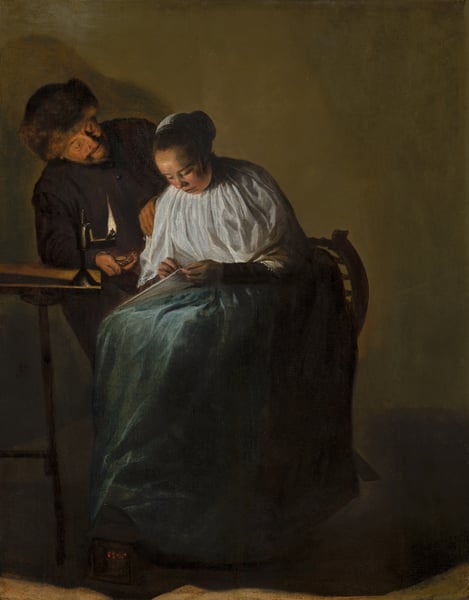
Meg Lota Brown, professor of English at the University of Arizona, and Kari Boyd McBride, professor of Women's Studies at the same, consider The Proposition to be "one of [Leyster's] most intriguing works from her period of greatest artistic output". Marianne Berardi, an art historian specializing in Dutch Golden Age painting, states that it is "perhaps her most notable painting". Its most distinctive feature is how different it is to other contemporary Dutch and Fleming "sexual proposition" paintings, many falling into the Merry company genre. The convention for the genre, a common one at the time, was for the characters to be bawdy, and clearly both interested in sex, for money. The dress would be provocative, the facial expressions suggestive, and sometimes there would be a third figure of an older woman acting as a procuress. Indeed, in The Procuress by Dirck van Baburen, an example of the genre, that is exactly the case.
In contrast, in The Proposition the woman is depicted not as a whore but as an ordinary housewife, engaged in a simple everyday domestic chore. She isn't dressed provocatively. She does not display her bosom (but rather her blouse covers her all of the way to her neck). No ankles are visible. And she displays no interest in sex or even in the man at all. Contemporary Dutch literature stated the sort of activity in which she is engaged to be the proper behaviour for virtuous women in idle moments. Kirstin Olsen observed that male art critics "so completely missed the point" that the woman is, in contrast to other works, not welcoming the man's proposition that they mistakenly named the painting The Tempting Offer.
The foot warmer, whose glowing coals are visible beneath the hem of the woman's skirt, was a pictorial code of the time, and represented the woman's marital status. A foot warmer wholly under the skirt indicated a married woman who was unavailable, as it does in The Proposition; a foot warmer projecting halfway out from under the skirt with the woman's foot visible on it indicated one who might be receptive to a male suitor; and a foot warmer that is not under the woman at all, and empty of coals, indicated a single woman. This code can also be seen in Vermeer's The Milkmaid and Dou's The Young Mother.
The feminist reinterpretation of the picture largely originated with the work of Frima Fox Hofrichter who pointed out in 1975 (Hofrichter 1975) the difference between Leyster's painting and others of the genre and that it had served to set a precedent for other, later, artists, such as Gabriël Metsu in his An Offer of Wine. According to Hofrichter, the woman in The Proposition is an "embarrassed victim" presented sympathetically and positively.
However, not all art historians agree unequivocally with Hofrichter. For example: Wayne Franits, professor of fine art at Syracuse University, later critiqued Hofrichter, observing that an offer of money was a common beginning of a courtship at the time, so the painting might depict a simple honest attempt at courtship. Franits suggests the "woman's unequivocally wholesome activity of sewing provided an important precedent for later genre paintings depicting domestic virtue". A number of later genre scenes remain ambiguous in a similar way, most famously The Gallant Conversation (or The Paternal Admonition) from circa 1654 by Gerard ter Borch (the Younger), and The Hunter's Gift by Metsu (both Rijksmuseum).
Museum / Gallery
Visueel vergelijkbaar
20 werken met verwante compositie en kleurenpalet
A man offers a young girl money
Judith Leyster
Before the ball
Petrus van Schendel
The Tippler (The Wine Drinker)
Gabriel Metsu
Jeune femme assise
Joseph Bail
Old Woman Cutting Bread
Gerrit Dou
Girl interrupted at her music
Johannes Vermeer
The Young Seamstress
Jean-Francois Millet
A Woman Scraping Parsnips, with a Child Standing by Her
Nicolaes Maes
The sale of the painting
Vito d'Ancona
Karneval
Petrus van Schendel
Mending time
Elisabeth Jerichau-Baumann
A Young Woman Sewing
Nicolaes Maes
Education of the Virgin
Georges de la Tour
The artist's wife reads in bed
Wenzel Tornøe
Woman with flowers
Angelo Inganni
A Young Lady Trimming Her Fingernails, Attended by a Maidservant
Jacob Ochtervelt
Young woman in an interior holding a glass
Cornelis Pietersz. Bega
The Love Letter
Jacob Ochtervelt
The new dress
Felix Schlesinger
The House of Nazareth
Francisco de Zurbaran