Description
Stijl: Mozarabic · Genre: miniature
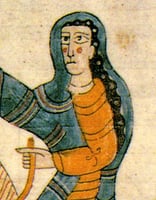
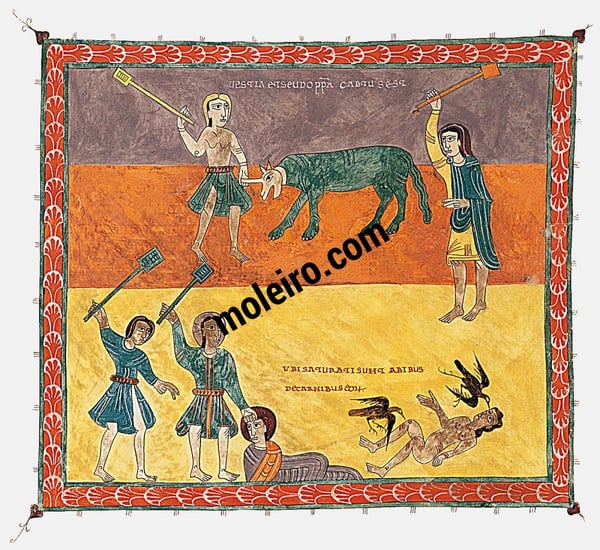
The illustration disregards the moment before the battle and represents only the contents of verse 20 and part of 21, i.e. the capture of the beast and the false prophet – in keeping with the legend in the top margin: “uestia et seudo p[ro]p[heta] cabtus est”– in a manner not mentioned in the storia. Two men armed with maces can be seen underneath striking the beast shown as a quadruped, with a horn upon its forehead which is grasped by a half-naked man in an attempt to capture the beast. Another two persons underneath are about to beat the false prophet wearing a nimbus who has fallen to the ground. One of them holds him by the hair to demonstrate control. The birds on the far right devour the body and the eyes of a naked, dead man, and the legend beside him reads “vbi saturati sunt abibus/de carnibus eor[um]”. The coloured strips show that the meaning of the colours depends on their context: hence red and yellow refer in all likelihood to the fire and brimstone into which the beast and false prophet were cast alive.
Apart from the absence of the corpse being eaten by the birds, stemma I Beatus differ considerably from each other and from stemma II manuscripts. The Escorial Beatus (f. 150r) – which is apparently the most faithful reflection of the early version – shows the beast spitting out a great deal of blood and seized by a man with a nimbus. Another man underneath is about to stab the false prophet lying dead alongside his followers with a knife. A similar image featuring the basic elements of a man capturing the beast and another killing the false prophet, could have influenced stemma II, whose most ancient model is apparently followed faithfully by Morgan (f. 211r) and Gerona. The capture of the beast does however give the impression of a genre scene, whilst the false prophet, rather than captured, is being executed – hence the image strays considerably from the storia. The layout of these two tenth-century manuscripts is repeated, albeit with certain variations, in branch IIb, since the figures in IIa are simplified: just one seizes the beast by an ear and strikes it, whilst the other beats the kneeling false prophet directly on his back. Depicted in the bottom, right part, beneath the beating of the false prophet, always without a nimbus, is the man devoured by the birds. Branch IIb, on the other hand, increases the number of figures, also in short tunics but without trousers, punishing the wicked, with the mace that is to strike them always held aloft. One man in the bottom part seizes the false prophet by the hair. Furthermore, the beast is always grasped by a horn or his snout.
Visueel vergelijkbaar
20 werken met verwante compositie en kleurenpalet
La Capture de la Bête et du Faux Prophète. Apoc. XIX
Facundus
The opening of the first four seals
Ende
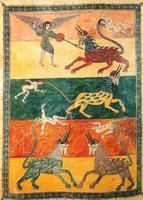
The angel of the abyss and the infernal locusts
Ende
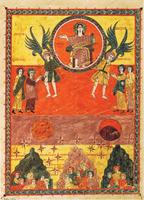
Beato de Gerona Fº 131v
Ende
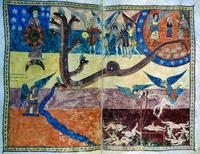
The woman garbed by the sun and the dragon
Ende
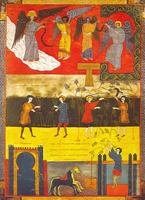
La Moisson et la Vendange. Apoc. XIV
Facundus
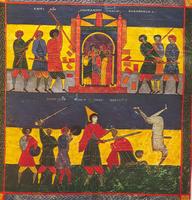
Les Nations foulent la Cité Sainte. Le meurtre des deux Témoins. La Bête Faux Prophète . Apoc. XI
Facundus
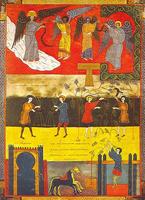
Beatus of Facundus
Facundus
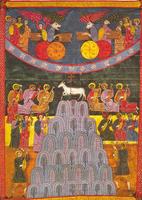
Adoration de l'Agneau mystique sur le Mont Sion.. Apoc. XIV
Facundus
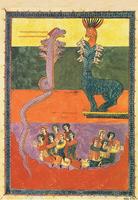
Beato de Gerona Fº 176v
Ende
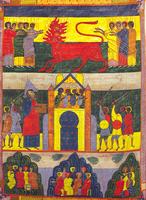
La Bête. Le Faux Prophète. Les Nations. Gog et Magog. Apoc. XX
Facundus
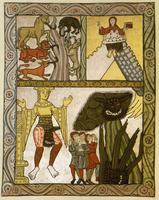
Vision of the Last Days
Hildegard of Bingen
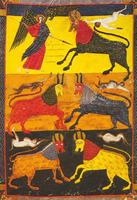
La cinquième Trompette. Les sauterelles se transforment en chevaux. Apoc. IX
Facundus
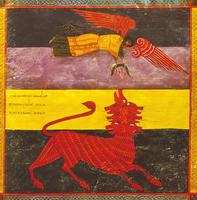
L'Ange répand la cinquième Coupe sur le Trône de la Bête. Apoc. XVI
Facundus
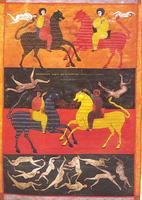
La sixième Trompette. Les myriades de Cavaliers tuant les Hommes. Apoc. IX
Facundus
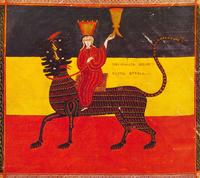
La Femme sur la Bête. Apoc. XVII
Facundus
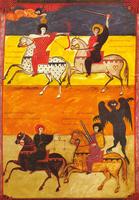
Les quatre Cavaliers. Apoc. VI
Facundus
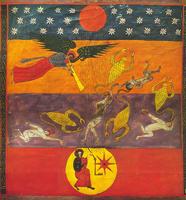
La cinquième Trompette. L'Astre tombé des Cieux. La clef du Puits de l'Abîme. Apoc. VIII
Facundus
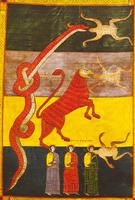
Les grenouilles sortent de la guele de la Bête, du Dragon et de la bouche du Faux Prophète. Apoc. XVI
Facundus
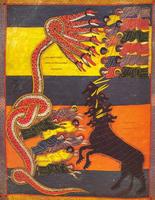
Le Dragon donne sa puissance à la Bête. Apoc. XIII
Facundus