
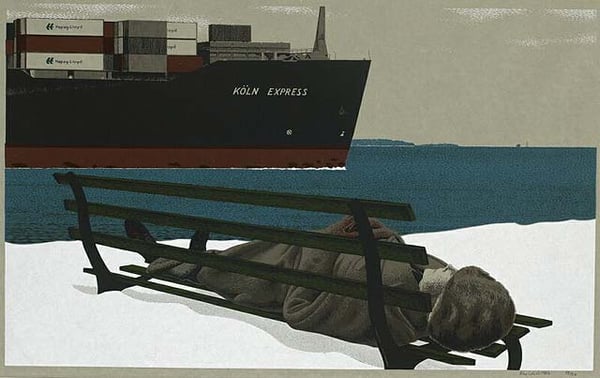
Expert analysis of Alex Colville’s Köln Express
Style: Contemporary Realism · Genre: genre painting
Expert Analysis of "Köln Express" by Alex Colville
Alex Colville’s Köln Express is a hallmark of Contemporary Realism, a movement that revitalized representational painting in the mid‑ to late‑20th century by infusing meticulous observational detail with a heightened sense of psychological tension. As a genre painting—a depiction of ordinary life—the work transcends mere documentation to become a quiet meditation on modernity, time, and human isolation.
Significance within Contemporary Realism: Colville’s style is defined by an almost photographic precision combined with subtle, deliberate distortions of perspective and composition. In Köln Express, this manifests in a crisply rendered train interior or station setting where every geometric line—seatbacks, window frames, lighting—feels both perfectly ordered and eerily detached. Such precision is not mere technical virtuosity; it serves to amplify the emotional stillness that Colville masterfully constructs. The scene is instantly recognizable yet uncanny, a signature of Contemporary Realism that refuses to let the viewer settle into passive observation.
Significance as Genre Painting: The choice to depict a mundane travel scene—likely a train named for Cologne (Köln)—elevates the everyday into a tableau of existential weight. Genre paintings traditionally illustrate common activities, but Colville’s approach transforms routine into ritual. The absence of dramatic action or explicit narrative forces attention on the figures’ postures, the play of artificial light, and the tension between movement (the express train) and frozen stillness (the painting itself). This tension is a central achievement: Köln Express captures the fleeting, impersonal nature of modern life while also inviting prolonged, almost cinematic contemplation.
Key Interpretive Elements:
- Isolation in Transit: Even if the painting includes multiple passengers, Colville often isolates his subjects through spatial arrangement or averted gazes, reflecting the contemporary experience of being surrounded yet profoundly alone.
- Time and Suspension: The frozen moment of a speeding train suggests both motion and inertia—a paradox that Colville frequently explores, blurring the boundary between past, present, and anticipation.
- Architecture of Anxiety: The repetitive, rational lines of train compartments become a framework for psychological tension, echoing the rationalist anxieties of post‑war society.
In summary, Köln Express is significant not only for its technical mastery but for how it uses the idioms of Contemporary Realism and genre painting to interrogate the quiet dramas of modern life. It stands as a testament to Colville’s ability to make the familiar strange, turning a simple journey into a resonant metaphor for the human condition.
Visually similar
20 works with related composition and palette
Burning Merit
Richard Hambleton

The Art of Logistics
Andrew Bench
Terminal
Sergey Ryabchenko
Illichivsk. Road to berths
Sergey Ryabchenko

Ada and Luisa
Alex Katz
Figures in the Park
Ian Bent
Untitled
Costas Niarchos

The Two Up Game (Portrait of Ermes De Zan)
Jeffrey Smart

Transport
Sue Coe

Girl on Park Bench
Charles Blackman
Cargo Cult (from the series Body Beautiful, Or Beauty Knows No Pain)
Martha Rosler
Containers at Pisa Airport
Jeffrey Smart
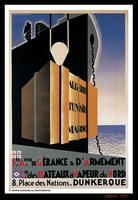
Saga
Cassandre
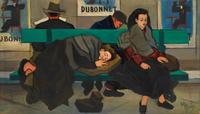
Les Clochards, Montmartre, Paris
Lois Mailou Jones
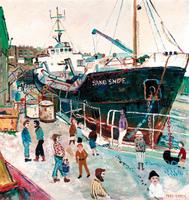
At the Harbour
Fred Yates
Untitled
Costas Niarchos
At the pier
Sergey Ryabchenko
From Brooklyn Heights
George Ault
Everyday life of the shipyard
Sergey Ryabchenko
Red Cargo, Naval Shipyard
Vasile Dobrian