
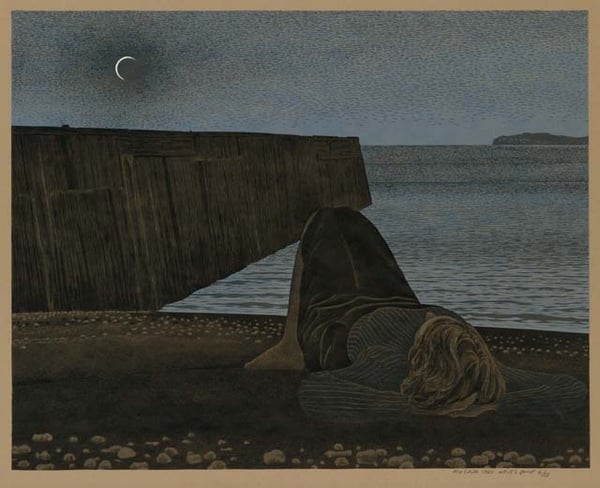
Expert analysis of Alex Colville’s New Moon
Style: Contemporary Realism · Genre: genre painting
Expert Analysis: "New Moon" by Alex Colville
Alex Colville’s New Moon (1980) exemplifies the hallmarks of Contemporary Realism—a style that marries meticulous, almost photorealistic detail with a cool, disquieting sense of narrative ambiguity. Painted in acrylic on Masonite, the work measures 12 x 24 inches, a modest scale that belies its psychological intensity. The scene depicts a solitary figure—a woman standing on a veranda or balcony at night, her back to the viewer, gazing upward at a sliver of new moon. The composition is rigorously balanced: the vertical lines of the wooden railing, the horizontal sweep of the porch floor, and the crisp edge of the building’s shadow create a grid-like structure that traps the figure in a moment of quiet, yet charged, stillness.
What makes New Moon significant within Colville’s oeuvre—and within Contemporary Realism as a whole—is its masterful use of “frozen narrative.” Colville rarely shows action; instead, he captures a pregnant pause that invites the viewer to construct a story. Here, the woman’s posture (arms slightly raised, perhaps reaching or simply resting on the railing) and the title’s reference to the lunar phase (symbolizing new beginnings, darkness, or hidden potential) create a tension between the ordinary (a nighttime moment) and the profound (a confrontation with the unknown). The light is surgically precise: a cool, silvery glow from the moon and a warm, artificial interior light spilling from a window, delineating the sharp, crisp shadows that are Colville’s trademark. The palette is restrained—deep blues, grays, and ochre—evoking a sense of isolation and introspection.
The artwork’s significance also lies in its defiance of narrative closure. Unlike many genre paintings that depict domestic or social routines, Colville’s scene is unsettling because it withholds explanation. The woman’s face is hidden; the environment is stark and geometric. This ambiguity forces the viewer to engage with the psychological undercurrents—loneliness, anticipation, or even dread—that are hallmarks of Colville’s vision. New Moon thus stands as a quintessential example of how Contemporary Realism can use hyper-precision not merely to record reality, but to render the invisible emotions that shape our perception of the everyday. It is a work that rewards slow, patient looking—a quiet meditation on the thresholds between light and shadow, presence and absence, the known and the mysterious.
Genre
Style
Visually similar
20 works with related composition and palette

Nordsee IV
Hans-Peter Emons

Windy weather
Carl Bloch
Breaking Waves at Heyst
Alfred William Finch
The Shore
Paul Nash
Portrait of Emma Bellwidt on the Beach at Domburg
Jan Toorop
Peter Grimes
Will Barnet
Sunbathers at Construction Site
Jeffrey Smart
The girl at the sea
Hanno Karlhuber
Symphony in Grey and Green: The Ocean
James McNeill Whistler
Journey to the Center of the Earth
Edouard Riou
Tracy On The Raft At
Alex Katz
Fishbone Forest
Max Ernst
At the Caspian Sea
Tahir Salahov
End of the Jetty, Honfleur
Georges Seurat
The River
O. Louis Guglielmi
Nova Kakhovka
Kinder Album
Untitled
Zdzislaw Beksinski
Winter Carnival, Viareggio
Jeffrey Smart
#021
Toshihiko Okuya
The Temptation Of Saint Anthony
Horace Pippin