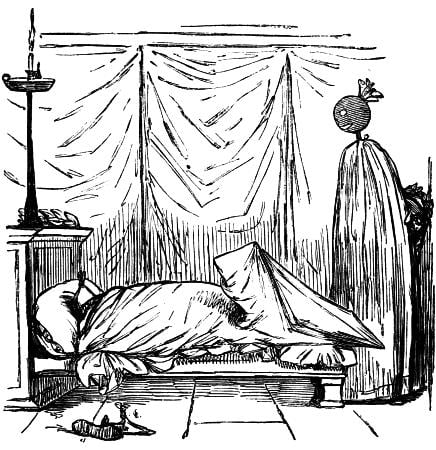
Awful Appearance of the Shade of Remus to Romulus
Dettagli
Analisi esperta di Awful Appearance of the Shade of Remus to Romulus di John Leech
Stile: Romanticism · Genere: illustration
Expert Analysis: "Awful Appearance of the Shade of Remus to Romulus" by John Leech
Although John Leech is primarily celebrated as a satirical caricaturist for Punch, this work—executed in the Romantic style and falling under the genre of illustration—reveals a striking departure into the sublime and the supernatural, making it a significant piece within both his oeuvre and the broader Romantic period.
Context and Subject Matter
The title invokes the foundational myth of Rome: Romulus, after killing his twin brother Remus, is confronted by his brother’s ghost. In Romanticism, such a subject allowed artists to explore the psychological weight of guilt, fate, and the uncanny. Leech’s choice to depict a spectral visitation taps into the Romantic fascination with the macabre, the supernatural, and the emotional extremes of human experience—the “awful” (awe-inspiring) rather than merely the horrific.
Stylistic Significance in Romanticism
- Emotional Intensity: The scene is charged with dramatic tension. The “shade” of Remus would likely be rendered with eerie, translucent forms and stark contrasts of light and shadow (chiaroscuro), a hallmark of Romantic illustration meant to provoke visceral dread and pity.
- Sublime Nature of the Supernatural: Romanticism prized the sublime—an overwhelming, often terrifying encounter with forces beyond human control. Here, the ghost embodies the inescapable moral consequence of fratricide. The illustration genre allowed Leech to distill this complex narrative into a single, potent image for a broad audience.
- Narrative Economy: As an illustration, the work must communicate its story instantly. Leech likely compresses the myth into a charged moment: Romulus recoiling, the shade pointing or hovering—an image that functions both as a stand-alone artwork and as a visual accompaniment to a literary text.
Significance within Leech’s Career and the Period
Leech is often pigeonholed as a humorist, but Awful Appearance of the Shade of Remus to Romulus demonstrates his mastery of Romantic gravitas and his ability to handle classical mythology with the same technical skill and emotional resonance as his better-known caricatures. It broadens our understanding of the Romantic illustration tradition, which frequently straddled high art and popular print culture. The work stands as an example of how Romantic ideals—the supernatural, the terrifying, the moral sublime—permeated even the seemingly lighthearted realm of periodical illustration, proving that the movement’s influence extended far beyond painting into the everyday visual experience of the 19th-century reader.
Genere
Stile
Visivamente simili
20 opere con composizione e palette affini
Paul de Kock. The Big City
Honore Daumier
Discreet (discrète)
Paul-Albert Besnard
Illustration to "A Week of Kindness"
Max Ernst
Illustration to Odyssey
John Flaxman
Don Quixote
Gustave Dore
Isolde discovers the notch in the sword of Tristan
Arthur Rackham
Jezebel Promising Naboth's Vineyards to King Ahab
Lucas van Leyden
Titus threatening Pomponius
John Leech
Don Quixote
Gustave Dore
Tarquinius Superbus has the Sibylline Books valued
John Leech
Birth of Mary
Albrecht Durer
The Grief of Andromache
Jacques-Louis David
Sex position '69'
Felicien Rops
Honoric, King of the Vandals, Eaten by Worms and Lice, AD 477
Jan Luyken
Illustration to "A Week of Kindness"
Max Ernst
Clytemnestra pushed by Mimi Veron (Rachel)
Honore Daumier
The Death of Mary
Albrecht Durer
Illustration to "A Week of Kindness"
Max Ernst
Illustration for the Poem "the Sailor's Bride"
Frederick Sandys
Joseph and Potiphar`s wife
Rembrandt