
Expertenanalyse zu John Leechs Rhea Silvia
Stil: Romanticism · Genre: illustration
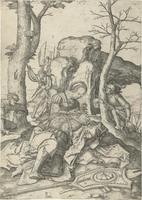
Analysis of "Rhea Silvia" by John Leech
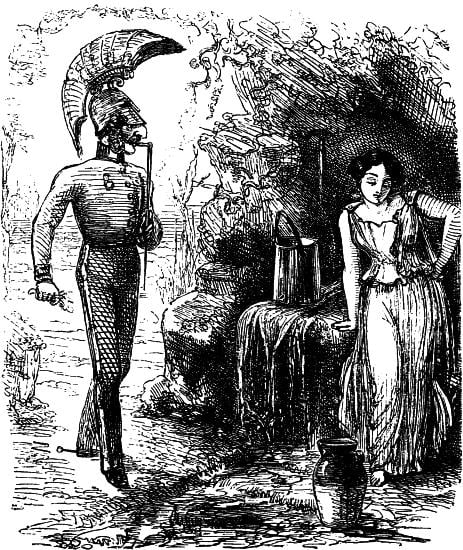
As an illustration executed within the Romantic tradition, John Leech’s Rhea Silvia occupies a fascinating intersection between popular visual culture and the sublime, emotional preoccupations of early 19th-century art. Leech is best known for his satirical cartoons in Punch, but this work demonstrates his engagement with classical mythology—a staple of Romanticism—through the lens of narrative illustration.
Significance within Romanticism and Illustration:
-
Romantic Treatment of a Classical Subject
The figure of Rhea Silvia—the mother of Romulus and Remus—was a potent Romantic symbol of tragic destiny and divine intervention. Leech does not merely depict a mythological episode; he imbues it with the emotional intensity characteristic of the movement. The contrast between the mortal heroine and the supernatural forces (the god Mars, or the she-wolf that later nurtures her sons) allows Leech to explore themes of fate, vulnerability, and heroic suffering—all central to Romantic sensibility. -
Elevating Illustration as a Medium
In the Romantic period, illustration was often dismissed as a lower form of art compared to history painting. Leech’s Rhea Silvia challenges this hierarchy by applying painterly drama and psychological depth to a printed image intended for a wider audience. The composition likely uses strong chiaroscuro and expressive gestures to convey Rhea Silvia’s anguish or awe, making the illustration a vehicle for the same sublime experiences found in grand Romantic canvases. -
Narrative Clarity and Symbolic Detail
As an illustrator, Leech prioritizes clear storytelling. Every element—from the drapery to the landscape—serves to reinforce Rhea Silvia’s pivotal moment. The work’s significance lies in its ability to condense a complex myth into a single, readable image without sacrificing emotional impact. This aligns with the Romantic valorization of personal, intuitive encounters with myth and nature.
Conclusion:
John Leech’s Rhea Silvia is significant as a Romantic reinterpretation of classical mythology through the accessible medium of illustration. It demonstrates how popular print culture adopted the movement’s core concerns—individual emotion, the sublime, and mythic resonance—while maintaining narrative legibility. In doing so, Leech bridges academic Romanticism and the broader public’s visual imagination, affirming illustration as a serious artistic practice within the period.
Visuell ähnlich
20 Werke mit ähnlicher Komposition und Farbpalette
Self-possession of Fabricius, the Ambassador, under rather Trying Circumstances
John Leech
The Romans clothed by the Inhabitants of Capua
John Leech
Virginia carried off by a Minion in the pay of Appius
John Leech
John the Baptist Beheaded, AD 23
Jan Luyken
Don Quixote
Gustave Dore
Curius Dentatus refusing the Magnificent Gift offered by the Samnite Ambassadors
John Leech
The Child and Death, after Hans Holbein the Younger
Wenceslaus Hollar
Don Quixote
Gustave Dore
Coriolanus parting from his Wife and Family
John Leech
Mucius Scævola before Porsenna
John Leech
Marius discovered in the Marshes at Minturnæ
John Leech
Femme
Charles Jacque
Belgische Armenwanderung
Daniel Chodowiecki
Martyrdom of Felicitas of Tuburbia in Mauretania, AD 201
Jan Luyken
Hannibal, whilst even yet a Child, swears Eternal Hatred to the Romans
John Leech
Don Quixote
Gustave Dore
Don Quixote
Gustave Dore
Diogenes and Alexander
Salvator Rosa
Christ and the woman of Samaria among ruins
Rembrandt
Samson and Delila
Lucas van Leyden