
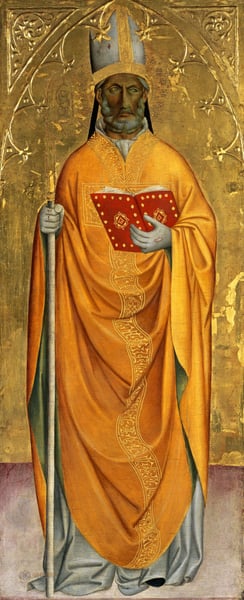
Expert analysis of Cennino Cennini’s Saint Augustine
Style: Proto Renaissance · Genre: religious painting
Expert Analysis: "Saint Augustine" by Cennino Cennini
This religious painting, executed in the Proto-Renaissance style, is a work of considerable art-historical significance due to the unique position of its creator, Cennino Cennini, as both a practitioner and a theorist. While the subject matter—Saint Augustine as a Church Father—is standard for the period, the painting’s importance lies not in iconographic innovation but in what it represents about artistic practice in the late Trecento.
Stylistic and Technical Significance
As a Proto-Renaissance work, "Saint Augustine" straddles the lingering Byzantine tradition (evident in the likely use of gold ground and hierarchical frontality) and the emerging naturalism of the 14th century. Cennini’s approach would have been deeply informed by the Florentine school, specifically the teachings of Giotto (via Agnolo Gaddi), emphasizing the rendering of volume, drapery, and human emotion within a sacred framework.
However, the painting’s true significance is that it serves as a visual analogue to Cennini’s famous treatise, Il Libro dell’Arte (c. 1400). This handbook systematically described the techniques of tempera painting—the medium used here—from gilding to modeling flesh tones. Therefore, "Saint Augustine" can be viewed as a practical demonstration of the very methods Cennini codified in writing. Every brushstroke, from the layered application of egg tempera to the precise handling of halos and drapery, reflects the transitional moment when artistic knowledge moved from secret workshop tradition to explicit, teachable craft.
Historical and Contextual Importance
Cennini’s work is significant because it marks a bridge between medieval and Renaissance thought. Unlike the purely devotional paintings of earlier centuries, "Saint Augustine" embodies the Proto-Renaissance shift toward intellectual inquiry. Saint Augustine himself, as a theologian and philosopher, was a fitting subject for an artist who believed painting should be grounded in rational technique and observation—a precursor to the Renaissance humanist ideal.
Moreover, Cennini was among the first artists to assert that painting was a noble profession deserving of the same status as poetry or science. In his treatise, he famously advised the painter to take delight in his craft, calling it "an art worthy of the name." Thus, this painting is not merely a devotional object; it is a manifesto of artistic self-consciousness, demonstrating that even a traditional religious subject could be a vehicle for technical mastery and intellectual rigor.
Conclusion
In the context of Proto-Renaissance religious painting, "Saint Augustine" by Cennino Cennini is significant because it encapsulates the fusion of practice and theory that would define the Renaissance. It stands as a tangible example of Trecento workshop methods while simultaneously representing a new attitude toward the artist’s role—a shift from anonymous craftsman to learned author. As both an artifact of devotional piety and a document of artistic transition, this painting offers a rare window into the foundational era of Italian Renaissance art.
Genre
Style
Visually similar
20 works with related composition and palette
Polyptych. Madonna and Child, Saint James the Great and Saint Henry (detail)
Ambrogio Bergognone
St. Stephen
Giotto
Saint Nicolas
Carlo Crivelli

St Lawrence
Giotto
St. Idelfonso
El Greco
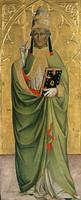
Saint Gregory
Cennino Cennini
Sant'Agostino
Il Sassetta (Stefano di Giovanni)
Saint Laurenzius
Carlo Crivelli
Passion (Greverade) Altarpiece (first closed position)
Hans Memling

St. Nicholas of Bari
Fra Angelico
Saint-Valentin
Jean Hugo
Statua Di San Nicola Nella Basilica Omonima
Giuseppe Barberis
Altar triptych from the Lübeck Cathedral (detail)
Hans Memling
Plaque with Bishop
Nicholas of Verdun
St. Fortunatus Enthroned
Benozzo Gozzoli
Ambroise Et Cecile
Stefan Lochner
Polyptych of Cervara: St. Jerome
Gerard David
Trittico della Natività (detail)
Gentile Bellini
San Giovenale Triptych. Left panel
Masaccio

A Bishop Saint
Fra Angelico