
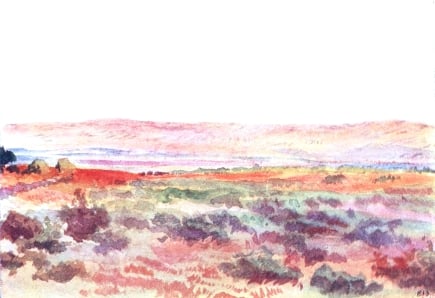
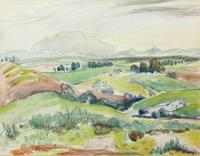
The Plain of the Jordan, looking from New Jericho towards Mount Pisgah
Dettagli
Analisi esperta di The Plain of the Jordan, looking from New Jericho towards Mount Pisgah di Elizabeth Thompson
Stile: Romanticism · Genere: landscape
Expert Analysis: "The Plain of the Jordan, looking from New Jericho towards Mount Pisgah" by Elizabeth Thompson
Elizabeth Thompson, known primarily for her dramatic military scenes (e.g., The Roll Call), here turns to landscape—a genre she mastered with equal Romantic intensity. This painting is significant within the Romantic movement for its fusion of sublime natural grandeur with profound biblical and historical resonance.
1. Romantic Sublime and Biblical Topography
Thompson captures the vast, sun-baked expanse of the Jordan Valley as a stage for spiritual reflection. The view from New Jericho toward Mount Pisgah (the site from which Moses glimpsed the Promised Land) transforms a geographical vista into a pilgrimage of the soul. The expansive sky, golden light, and distant hazy mountains evoke the Romantic sublime—nature's overwhelming scale that inspires awe and humility. This is not a mere topographical record but a meditation on providence, exile, and promised redemption.
2. Synthesis of Historical and Emotional Landscape
Romanticism prized the union of history and emotion, and Thompson achieves this by anchoring the scene in a specific biblical narrative. The viewer is invited to share the moment of Moses' vision, making the landscape an emotional conduit. The warm, glowing tones and the sweeping, unbroken horizon suggest both the physical aridity of the region and the spiritual thirst for fulfillment—a quintessentially Romantic tension between worldly desolation and eternal hope.
3. Significance Within Thompson's Oeuvre and Romanticism
As a female artist in the 19th century, Thompson's choice of a majestic, historically charged landscape was bold. She demonstrates that Romantic landscape could be as dramatic and meaningful as history painting. The work stands as a testament to the movement's core belief: that nature, when observed through a lens of faith and history, becomes a vehicle for transcendent human experience. Its significance lies in its ability to render a specific, holy geography as a universal allegory of longing and revelation.
Visivamente simili
20 opere con composizione e palette affini
Wind of Wyoming
Maynard Dixon
Galilee, looking towards Hermon
Elizabeth Thompson
The Plains from Nazareth
John Singer Sargent
Mont Sainte-Victoire Seen from les Lauves
Paul Cezanne
Jackson Hole, Wyoming
Ivan Albright
Landscape with Flowering Orchard
Paul Wonner
Krasnoyarsk vicinities
Vasily Surikov
Cottonwood III
Georgia O'Keeffe
Tregor and Tregoff, Cornwall
David Bomberg
Abandoned Ranch
Maynard Dixon
Dunes at Shinnecock
William Merritt Chase
Scene from the Train Window
Martiros Sarian
Landscape with Tree
Maurice Braun
First Touch of Autumn
William Merritt Chase
The Lake of Tiberias
John Singer Sargent
Ayunkara
George Washington Lambert
Thunderstorm on the Oregon Trail
Childe Hassam
Untitled Landscape, Bellport (No.942)
Arthur Pinajian
Pass Tangla
Nicholas Roerich
Landscape with Cottage
Maggie Laubser