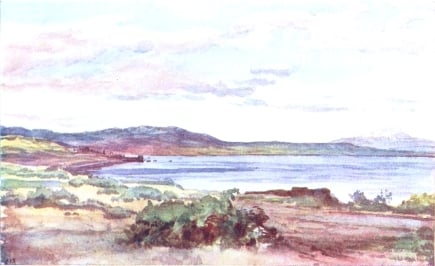
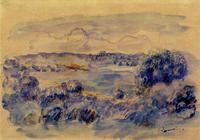
Galilee, looking towards Hermon
Dettagli
Analisi esperta di Galilee, looking towards Hermon di Elizabeth Thompson
Stile: Romanticism · Genere: landscape
Expert Art Historical Analysis: "Galilee, looking towards Hermon" by Elizabeth Thompson
Elizabeth Thompson (1846–1933), better known as Lady Butler, is celebrated for her epic military scenes such as The Roll Call and Scotland Forever! Yet this landscape—Galilee, looking towards Hermon—reveals a lesser-known but equally compelling dimension of her practice. Executed in the Romantic style, the work transforms a specific geographic vista into a deeply spiritual and emotionally charged vision.
Stylistic Significance within Romanticism
The painting embodies the Romantic preoccupation with the sublime—awe mixed with terror in the face of nature’s vastness. Thompson depicts the Sea of Galilee (Lake Kinneret) receding toward the distant, snow-capped peak of Mount Hermon. The composition likely employs a broad, panoramic sweep, with the lake reflecting the sky and the mountain dominating the horizon. Romantic landscape painters such as Caspar David Friedrich used such vistas to evoke both the insignificance of the human figure and the overwhelming presence of the divine. Thompson follows this tradition, but with a crucial twist: her subject is not an unnamed Alpine peak or a northern forest, but a place laden with biblical history.
Cultural and Religious Resonance
Galilee and Hermon are central to the Gospels—the site of Christ’s ministry and the traditional location of the Transfiguration. By choosing this specific view, Thompson infuses her Romantic landscape with typological meaning. The mountain becomes a symbol of transcendence; the lake, a mirror of eternity. The work thus functions as a kind of landscape of pilgrimage, inviting the viewer to experience not just a scenic overlook, but a sacred geography. In an age of increasing secularization, Thompson’s painting affirms the enduring power of faith through the Romantic lens of personal, emotional encounter with nature.
Significance in the Artist’s Career and Art History
Thompson was a trailblazing female artist in a field dominated by men, especially in the genre of history and military painting. This landscape demonstrates her versatility and her ability to compete with male contemporaries in the prestigious realm of “high” landscape painting. Moreover, while her battle scenes emphasize human heroism and pathos, Galilee, looking towards Hermon redirects that emotional intensity toward the silent drama of the natural world. The work stands as a testament to Romanticism’s belief that landscape could be as profound and moving as the most heroic narrative. Its quiet grandeur, combined with its deep religious undercurrent, makes it a significant—if overlooked—example of how a Victorian female artist could command the sublime.
Visivamente simili
20 opere con composizione e palette affini
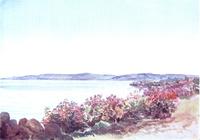
Galilee, looking from near the mouth of the Jordan towards the Mount of Beatitudes and Tabor
Elizabeth Thompson
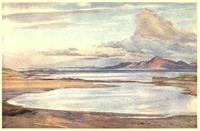
Clew Bay, Co. Mayo
Elizabeth Thompson
The Plain of the Jordan, looking from New Jericho towards Mount Pisgah
Elizabeth Thompson
The Lake of Tiberias
John Singer Sargent
Krasnoyarsk vicinities
Vasily Surikov
Lake Geneva from the Caux
Ferdinand Hodler
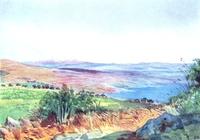
Our First Sight of Lake Galilee
Elizabeth Thompson
Coast Scene
David Cox
Lake Ladoga Islands
Nicholas Roerich
Spring in Crimea
Zinaida Serebriakova
Landscape with a Windmill and Village
John Absolon
The Dead Sea, Jordan
Edward Lear
Morocco
Nicholas Roerich

View from Castiglioncello
Odoardo Borrani
Sea of Galilee
Vasily Polenov
Landscape at Volga
Isaac Levitan
Llyn Treweryn
Augustus John
Wind of Wyoming
Maynard Dixon
The Cape 'Flats'
Elizabeth Thompson
Guernsey Landscape
Pierre-Auguste Renoir