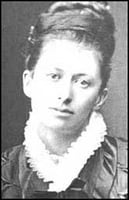
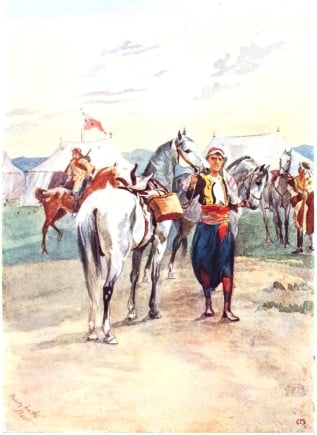
Expert analysis of Elizabeth Thompson’s The Start. Frontispiece
Style: Romanticism · Genre: illustration
Expert Analysis of "The Start. Frontispiece" by Elizabeth Thompson
Elizabeth Thompson (later Lady Butler) created this work within the Romantic tradition, a period that prized emotional intensity, dramatic narrative, and the heroic individual. As a frontispiece—the introductory illustration of a book—this piece holds a double significance: it both sets the tone for the literary work it accompanies and exemplifies Romanticism’s embrace of storytelling through visual art.
What makes "The Start. Frontispiece" distinctive within Romanticism is its intersection of illustration with a profound human moment. The title suggests a beginning—perhaps a military departure or an expedition—a theme Thompson frequently explored in her celebrated battle scenes. Here, however, the focus is not on combat but on the poignant instant of departure, capturing the Romantic fascination with transitional, emotionally charged moments. The “start” implies uncertainty, courage, and the weight of what is left behind, all core Romantic concerns.
Thompson’s significance lies in her ability to humanize history. Unlike many male Romantic painters who emphasized grandiose heroism, she often portrayed soldiers as vulnerable individuals. This frontispiece likely employs a composition that draws the viewer into the protagonists’ private resolve, using atmosphere and gesture rather than overt action. As an illustration, it serves a narrative function while standing alone as a powerful Romantic image—a confluence of word and picture that amplifies the emotional stakes of the story it introduces.
In the context of Romantic art, "The Start. Frontispiece" is significant for demonstrating how illustration can be elevated to high art, merging the period’s love for epic storytelling with Thompson’s unique gift for sympathetic, understated drama. It reminds us that Romanticism’s “hero” is often found not in victory, but in the quiet act of beginning.
Visually similar
20 works with related composition and palette
Camp In The Desert
Giulio Rosati
Encampment of the Pilgrims at Jericho
David Roberts
Watching for the Smoke Signal
Charles M. Russell
A stop in the desert
Giulio Rosati
Charge of the Heavy Cavalry Brigade, 25th Octomber 1854
William Simpson
It's the Emir
Gustave Boulanger
Two hawks (Bashi-bazouk)
Vasily Vereshchagin
About the war
Vasily Vereshchagin
Desert nomads
Giulio Rosati
The Return
Gustave Boulanger
Albanian Warrior
Jean-Leon Gerome
Powder Play City of Morocco, outside the Walls
Edwin Lord Weeks
The Battle of Tetouan (detail)
Marià Fortuny
Mounted Mamelucke
Carle Vernet
A Horseman Stopping In Front Of A Bedouin Encampment
Giulio Rosati
Hero
Viktor Vasnetsov
Valencian fair
Joaquín Agrasot
The Attack
Charles M. Russell
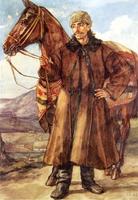
Ukrainian
Henryk Rodakowski
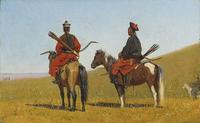
Two Chinese horsemen on the steppe
Vasily Vereshchagin