
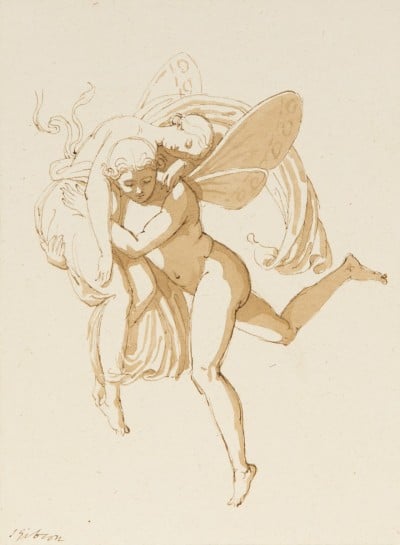
Psyche borne by a Zephyr
Expert analysis of John Gibson’s Psyche borne by a Zephyr
Style: Neoclassicism · Genre: sketch and study
Expert Analysis: "Psyche borne by a Zephyr" by John Gibson (Neoclassical sketch and study)
John Gibson’s Psyche borne by a Zephyr holds a unique place within Neoclassicism: it is a rare surviving sketch and study by a sculptor primarily celebrated for his finished marble works. While Neoclassicism typically prizes polished, idealized forms and monumental narratives from antiquity, this drawing reveals the working mind of an artist who translated mythological grace into three-dimensional sculpture.
Significance within Neoclassicism
The subject—Psyche, the personification of the soul, gently carried by the west wind Zephyr—is drawn directly from Ovid’s Metamorphoses and Apuleius’s The Golden Ass, a quintessential Neoclassical source. Gibson’s treatment, however, emphasizes lightness and motion rather than static, heroic grandeur. The sketch captures a fleeting, airborne moment that anticipates the dynamic, flowing drapery and weightless poses he would later achieve in marble—most notably in his Tinted Venus (1851–56). This study is essential for understanding how Gibson merged the linear clarity of Neoclassical draftsmanship (in the tradition of Flaxman and Ingres) with a softer, almost Romantic sensitivity to atmosphere and ethereality.
Technical and Conceptual Role
As a sketch and study, the work functions as a “thinking” document. Gibson uses delicate, rapid lines to suggest Zephyr’s billowing breath and Psyche’s suspended form, deliberately leaving areas unfinished. This spontaneity contrasts with the finished, highly polished surfaces of Neoclassical sculpture, offering insight into Gibson’s process of refining composition and balance. The study also reflects the contemporary interest in concetto (the conceptual idea) as a guide to execution—a method championed by Antonio Canova, whose Psyche Revived by Cupid’s Kiss (1787–93) was an inescapable influence. Gibson’s version, however, focuses on the moment before the lovers meet, emphasizing isolation and transience rather than reunion.
Broader Artistic Importance
Gibson was a British expatriate working in Rome, deeply embedded in the international Neoclassical circle. This study exemplifies his contribution to the ideal sculptural sketch—a genre that, while common in painting, was rarer among sculptors. It demonstrates that Neoclassicism was not simply about copying antique models but also about exploring delicate, ephemeral themes through controlled, graceful draftsmanship. The piece thus stands as a pivotal bridge between the rigid empire style of the early 19th century and the more fluid, sentimental Neoclassicism of mid-century, prefiguring the Pre-Raphaelites’ interest in poetic mythology.
In summary, Psyche borne by a Zephyr is significant not only for its technical elegance but for its role as a conceptual seed—a glimpse into the creative ferment behind Gibson’s cool marble facades, and a testament to the enduring Neoclassical fascination with the boundary between the material and the miraculous.
Visually similar
20 works with related composition and palette
A putto pursuing a butterfly
John Gibson
Mercury and Psyche
Giovanni Battista Piranesi
Allegory of the French People Offering the Crown and Sceptre to the King
Jacques-Louis David
Gemini and Virgo
Giovanni Battista Piranesi
Mercury and Ceres flying through the air
Hans von Aachen
Glaucus and Scylla
Salvator Rosa
Abduction Of A Woman (Rape Of The Sabine Women)
Albrecht Durer
Venus and Cupid
Giovanni Battista Piranesi
Mercury
Giovanni Battista Piranesi
Apollo pursuing Daphne
Aubrey Beardsley
Allegory of Time and Art
Bartholomeus Spranger
Studies of children
Luc-Olivier Merson
Nude Study (Nude Female from the Back)
Albrecht Durer
Psyche presenting Venus with water from the Styx
Raphael
Spring
Wojciech Siudmak
The Original Sin (Adam and Eve)
Bartholomeus Spranger
Love the conqueror
Léon Bazile Perrault
The Chimera
Gustave Moreau
Illustration to Odyssey
John Flaxman
Venus Punishing Profane Love
Agostino Carracci