Expert analysis of Joseph Farquharson’s Corn Stooks
Style: Realism · Genre: landscape
Expert Analysis: "Corn Stooks" by Joseph Farquharson
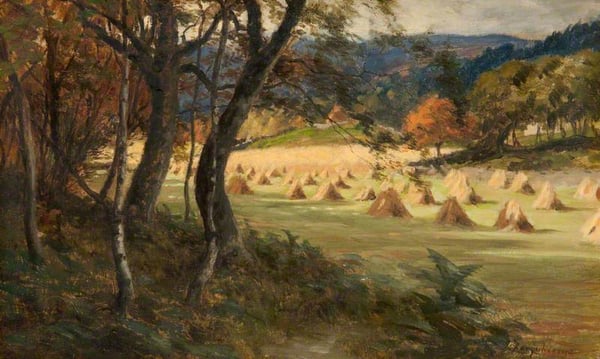
Joseph Farquharson’s Corn Stooks is a masterful example of late‑19th‑century Realist landscape painting, distinguished by its meticulous observation of rural life and atmospheric precision. Farquharson, a Scottish painter renowned for his depictions of the countryside—especially scenes involving sheep and snow—here turns his attention to the harvest season.
Composition and Subject:
The painting presents a field of gathered corn sheaves (or “stooks”) set against a broad, open landscape. Farquharson’s Realist approach is evident in the careful rendering of each stalk, the textures of the straw, and the subtle variation of colors as the stooks catch the changing light. The composition leads the eye from the foreground, where the stooks are most crisply defined, toward a distant horizon, suggesting the vastness of the agricultural land.
Atmosphere and Light:
Farquharson was a pioneer of plein‑air painting in Scotland, and Corn Stooks benefits from his firsthand study of natural light. The work captures a specific moment—likely late afternoon or early autumn—where a soft, diffused glow warms the golds and ochres of the stooked grain, while cooler shadows in the sky and earth create a balanced tonal harmony. This sensitivity to transient weather effects is a hallmark of his style.
Significance within Realism:
What makes Corn Stooks significant is its uncompromising fidelity to the ordinary rhythms of Scottish rural life. Unlike more romanticized or idealized portrayals of agriculture, Farquharson presents the stooks as real, functional objects shaped by labor and the natural cycle. His precise brushwork and controlled palette elevate a humble subject into a study of quiet dignity—a key concern of the Realist movement. The painting also exemplifies Farquharson’s ability to convey depth and atmosphere without sentimentality, influencing later Scottish landscape painters who valued authenticity over picturesque cliché.
Legacy:
While Farquharson is best known for snowy scenes such as The Lonely Shore, Corn Stooks demonstrates the breadth of his realism. It stands as a testament to his belief that the most humble aspects of the natural world—the tilt of a stook, the fall of light on a sheaf—are worthy of the highest artistic attention. In its unpretentious accuracy, the painting remains a powerful document of 19th‑century agricultural life and a refined achievement in British landscape art.
Visually similar
20 works with related composition and palette
Harvesting, Forest of Birse, Aberdeenshire
Joseph Farquharson
Harvest Fields
William Gilbert Foster
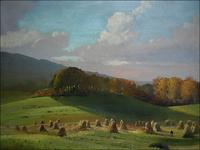
Corn Stacks, Pownal , VT
Frank Mason
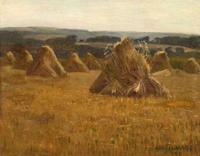
Corn Stacks
Algernon Talmage
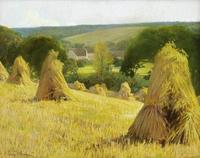
Sheaves of corn
Firmin Baes
Haymaking
Isaac Levitan
Cloud. Study
Fyodor Vasilyev
A cornfield
George Vicat Cole
Golden Grain
Daniel Sherrin
The Harvest at Montfoucault 2
Camille Pissarro
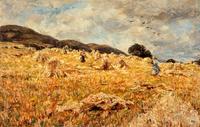
A Cornfield near Wooler
James Charles
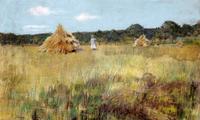
Grain Field, Shinnecock Hills
William Merritt Chase
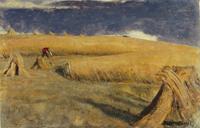
Cornfield at Ewell
William Holman Hunt
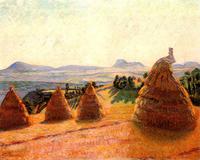
Plateau Bromont at Pontgibaud (Puy de Dôme)
Armand Guillaumin
By late summer, on the Volga
Aleksey Savrasov
Wheat Fields with Stacks
Vincent van Gogh
Harvest Field
Jane Sutherland
Threatening Weather
James Charles
Harvest
Zinaida Serebriakova
Pejzaz ze stogami
Ferdynand Ruszczyc